Why Does Jacob Give Judah the Royal Blessing Instead of Joseph?
Genesis 49 Explained: Judah’s Lion, the Scepter, Joseph’s Blessing, and the Unexpected Division of Israel’s Future
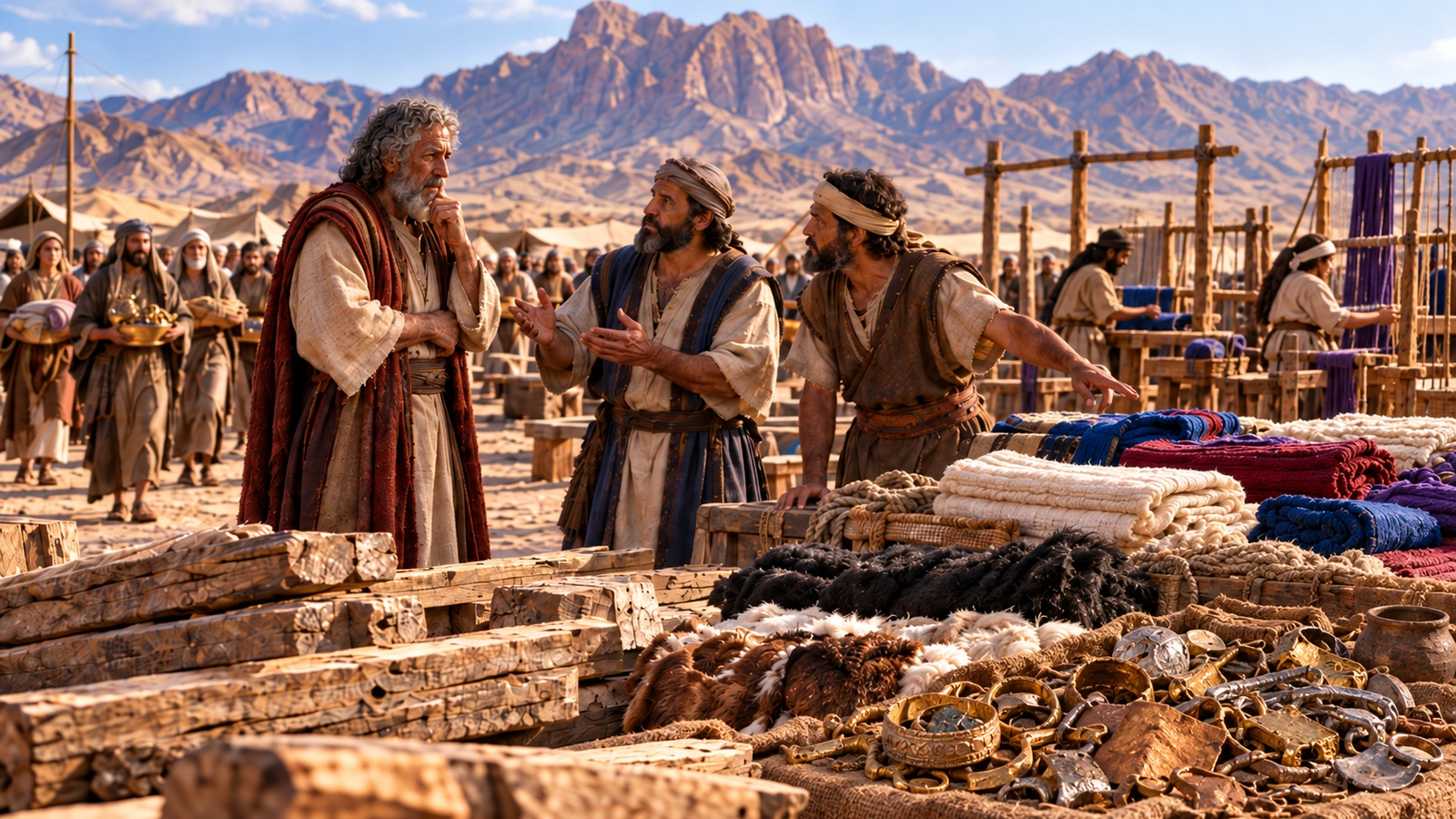
Figure 1. Jacob gives Judah words of royal authority while Joseph and the other brothers listen, illustrating the lion and scepter imagery of Genesis 49:8–12.
Source: AI-generated image created for Beyond The Known.

Why Does Jacob Bless the Younger Son Instead of the Firstborn? ended with another reversal. Joseph received exceptional standing through Ephraim and Manasseh. The younger grandson even moved ahead of the elder.
Everything still seems to favor Joseph’s house.
Then Jacob gathers all twelve sons.
Joseph receives one of Genesis 49’s richest pronouncements. Yet he does not receive the scepter.
That language goes to Judah.
The brother who governs Egypt will not carry Israel’s ruling line. Instead, royal imagery becomes attached to Judah’s descendants.
Why?
Genesis never says Judah receives kingship because Joseph failed. Nor does Jacob explain his private reasoning.
The chapter does something more complex.
It divides forms of preeminence that readers might expect one son to inherit.
Genesis 49 Is Not Twelve Identical Blessings
Jacob gathers his sons to announce what lies ahead.
The Hebrew introduction says:
בְּאַחֲרִית הַיָּמִים — bəʾaḥărîṯ hayyāmîm
The phrase points toward a coming period or future days.
It does not require an end-of-world meaning here.
What follows is also uneven.
Reuben hears that his former preeminence will not continue. Simeon and Levi receive words of scattering. Judah receives praise and governing imagery. Joseph receives exceptional fertility and favor.
Genesis 49:28 later calls the speeches blessings. Yet individual oracles can contain judgment, rebuke, prediction, and praise.
Jacob is not distributing one identical privilege twelve times.
He is mapping different futures onto Israel’s sons and, through them, their tribes.
That distinction becomes essential once Judah and Joseph are compared.
Reuben Starts With the Status Others Will Divide
The first son addressed is Reuben.
Jacob calls him:
בְּכֹרִי — bəḵōrî
“my firstborn.”
Biological priority belongs to him.
Jacob also describes Reuben as possessing an original superiority in dignity and strength.
Then the speech reverses direction.
Because Reuben violated his father’s bed, he will not retain that position. Genesis 35:22 had already recorded the act involving Bilhah.
Chapter 49 gives the consequence.
Birth order remains a fact.
Preeminence does not.
That separation opens the central problem of the chapter: if Reuben loses his superior standing, where does it go?
Simeon and Levi Do Not Simply Move Up
The next two brothers might appear to be obvious alternatives.
Jacob’s words remove that expectation.
Simeon and Levi are associated with the violence at Shechem. Their oracle ends with dispersion:
אֲחַלְּקֵם בְּיַעֲקֹב — ʾăḥalləqēm bəYaʿăqōḇ
“I will divide them in Jacob.”
Then:
וַאֲפִיצֵם בְּיִשְׂרָאֵל — waʾăp̄îṣēm bəYiśrāʾēl
“I will scatter them in Israel.”
By verse 7, the first three sons have not received the leadership language expected from a straightforward birth-order system.
Now the fourth son hears his name.
Judah’s Name Opens With Praise
Jacob begins Judah’s oracle with wordplay:
יְהוּדָה אַתָּה יוֹדוּךָ אַחֶיךָ — Yəhûḏāh ʾattāh yôḏûḵā ʾaḥeḵā
“Judah, your brothers shall praise you.”
The sound relationship between יְהוּדָה — Yəhûḏāh and יוֹדוּךָ — yôḏûḵā is deliberate.
Genesis had already connected Judah’s name with praise at his birth.
Jacob now turns that sound toward recognition from his brothers.
The next line raises the stakes.
Judah’s hand will be on the neck of his enemies.
Then Jacob says:
יִשְׁתַּחֲווּ לְךָ בְּנֵי אָבִיךָ — yištaḥăwû ləḵā bənê ʾāḇîḵā
“your father’s sons shall bow down to you.”
Readers of Genesis have heard this kind of language before.
They heard it around Joseph.
Joseph’s Dreams Make Judah’s Oracle More Surprising
Joseph’s dreams anticipated members of his family bowing before him.
The Egyptian episodes later make that pattern concrete.
His brothers repeatedly bow in his presence while seeking grain.
Yet those dreams concern Joseph’s own elevation.
They never explicitly promise that permanent Israelite monarchy will descend through his tribe.
That difference matters.
Joseph possesses real political authority in Egypt.
Genesis 49 looks toward tribal futures inside Israel.
Personal office and hereditary royal destiny are not identical categories.
The chapter allows Joseph’s dreams to stand while giving Judah another form of supremacy.
Judah Becomes a Lion
Verse 9 changes imagery:
גּוּר אַרְיֵה יְהוּדָה — gûr ʾaryēh Yəhûḏāh
“Judah is a lion’s cub.”
The poetry moves from a young lion to an animal crouched in security.
Who would dare disturb it?
Within ancient Near Eastern visual culture, lions could communicate strength, danger, divine power, or royal force. The symbol was not uniquely Israelite.
Old Babylonian cylinder seals offer useful comparisons. One British Museum example depicts a king carrying a mace alongside several lion figures. Another places royal and divine figures within scenes combining staffs, weapons, and lions. These artifacts do not verify Jacob’s speech or establish its date. They show that rulers, insignia of authority, and powerful animals belonged naturally within the symbolic world of the ancient Near East.
Genesis needs no imported code to explain Judah.
The verse itself presents him as formidable.
Then comes a much less ambiguous political image.
The Scepter Changes the Question
Genesis 49:10 contains the central governing language:
שֵׁבֶט — šēḇeṭ
followed by:
מְחֹקֵק — məḥōqēq
English translations vary over the exact rendering of each term.
“Rod,” “scepter,” “ruler’s staff,” and related expressions appear because the Hebrew words have broader ranges.
Inside this poetic parallel, however, governing authority is difficult to miss.
The scepter will not depart from Judah.
The ruler’s staff remains associated with his line.
Jacob has moved beyond physical strength.
Judah’s future now involves continuing rule.
But one correction is essential.
This is not the first time Genesis has mentioned kings.
Genesis 49 Does Not Invent Royal Expectation
God had already told Abraham that kings would come from him.
Sarah receives a related promise in Genesis 17:16.
Later, Jacob hears that kings will come from his own body in Genesis 35:11.
Royal expectation therefore predates the deathbed scene.
Genesis 49 does something more specific.
Earlier promises say kings will emerge from the patriarchal family.
Jacob now locates the scepter within Judah.
That narrowing is the new development.
The promise of kingship is not created here.
Its tribal direction becomes clearer.
Genesis 49:10 Then Reaches Its Hardest Hebrew Phrase
After the scepter and ruler’s staff comes:
עַד כִּי־יָבֹא שִׁילֹה — ʿaḏ kî-yāḇōʾ šîlōh
The problem is שִׁילֹה — šîlōh.
Its interpretation has been disputed for centuries.
Several major readings remain in circulation.
One understands the wording as a reference to Shiloh, the place.
Another interprets the expression along the lines of “until tribute comes to him.”
A further tradition understands it as “until he comes to whom it belongs.”
Older Jewish and Christian interpretations have also treated “Shiloh” as a personal or messianic designation.
Modern translations reflect that disagreement.
Serge Frolov’s study of the phrase argues that claims of consensus around the “tribute” interpretation remain premature. Even that proposal, despite its contextual strengths, faces grammatical and orthographic difficulties.
That uncertainty must remain visible.
A disputed Hebrew phrase should not be turned into artificial certainty.
Judah’s Royal Reading Does Not Depend on Solving Šîlōh
Fortunately, the central argument does not rest on one obscure expression.
Before šîlōh appears, Judah already has the scepter.
The ruler’s staff stands beside it.
His brothers have been pictured bowing.
The lion image has established power.
After the disputed clause, the poem still speaks about the response of peoples.
Even translations that disagree sharply over šîlōh preserve the surrounding governing framework.
The uncertainty affects how verse 10’s horizon should be understood.
It does not remove Judah’s association with authority.
That distinction allows the passage to remain both strong and honest.
Judah’s Future Includes More Than Warfare
Verses 11–12 turn from rule toward abundance.
Vines, wine, grapes, and milk dominate the imagery.
The poetry deliberately exceeds ordinary agricultural description.
A donkey can be tied to a choice vine because produce is pictured as plentiful.
Wine appears in extravagant quantity.
The point is not merely battlefield success.
Judah’s future combines authority with agricultural prosperity.
Strength and abundance belong to the same poetic horizon.
Then Jacob turns toward the brother readers may still expect to receive everything.
Joseph.
Joseph Is Not Reduced So Judah Can Rise
If Judah receives royal language, does Joseph lose his favored position?
Genesis answers by giving Joseph one of the chapter’s richest speeches.
Jacob describes him with:
בֵּן פֹּרָת יוֹסֵף — bēn pōrāṯ Yôsēp̄
“Joseph is a fruitful son.”
Hostility has struck him, yet he remains firm.
The language then expands through blessing above and below.
Heaven, the deep, fertility, and ancestral abundance surround his future.
Joseph is not demoted into irrelevance.
Genesis 48 has already elevated Ephraim and Manasseh into Jacob’s own tribal structure.
Two sons of Joseph now stand alongside Jacob’s sons.
That arrangement gives Joseph an extraordinary inheritance position.
Genesis 49 does not cancel it.
What Joseph lacks is Judah’s specific ruling vocabulary.
Judah and Joseph Receive Different Forms of Preeminence
This is where a later biblical text becomes unusually helpful.
First Chronicles 5:1–2 looks back on Reuben, Joseph, and Judah together.
It says Reuben lost his birthright after defiling his father’s bed.
That birthright went to Joseph’s sons.
Then the writer adds that Judah became prominent among his brothers and that a ruler came from him, while the birthright belonged to Joseph.
The distinction is remarkably close to the pattern already visible in Genesis 48–49.
Joseph receives the firstborn-related inheritance advantage.
Judah becomes associated with rulership.
One brother does not need to lose every privilege for another to rise.
The inheritance has been divided.
Does Judah Receive Kingship Because He Changed?
Genesis makes this question understandable.
Judah is not the same figure at the end of the Joseph story that he was near its beginning.
In Genesis 37, he proposes selling Joseph rather than killing him.
Chapter 38 later records his admission concerning Tamar:
צָדְקָה מִמֶּנִּי — ṣāḏəqāh mimmennî
“She is more righteous than I.”
The final Joseph episodes display an even larger behavioral change.
Judah guarantees Benjamin’s safety.
When Benjamin faces enslavement, Judah offers himself instead.
The narrative contrast is strong.
Earlier, another brother’s loss served Judah’s interests.
Later, he accepts personal loss to protect a brother.
That development prepares readers to see him differently.
Yet Genesis 49 never says Jacob grants the scepter because Judah offered himself.
Turning that sequence into Jacob’s stated motive would exceed the text.
Jacob’s Private Reasoning Remains Hidden
This is an easy place to overstate the story.
Jacob knows Judah guaranteed Benjamin’s return.
He knows the brothers came back from Egypt together.
Genesis does not specify how much Jacob learned about Judah’s long speech before Joseph or the silver-cup crisis.
Readers possess the full narrated scene.
Jacob may not.
Literary preparation is not identical to character psychology.
We can responsibly say Judah’s development makes his later prominence narratively intelligible.
We cannot invent a sentence inside Jacob’s mind.
The distinction protects the argument rather than weakening it.
Judah Was Already Moving Toward Leadership
Judah’s prominence does not suddenly appear in Genesis 49.
When Jacob initially refuses to send Benjamin, Reuben fails to persuade him.
Judah later succeeds.
He accepts responsibility and becomes the effective spokesman.
Before Joseph reveals himself, Judah delivers the longest plea in the confrontation.
Genesis 46:28 then says Jacob sends Judah ahead toward Joseph in Goshen.
None of these episodes explicitly calls him a king.
Together they give him growing narrative weight.
The scepter oracle therefore falls on a character already moving toward leadership among his brothers.
Still, Joseph looks like the obvious political candidate.
That contrast is intentional.
Joseph Has the Government Experience Judah Lacks
Joseph has governed at the highest level.
Pharaoh placed him over Egypt’s administration.
He manages grain during famine.
Foreigners and Egyptians alike operate within policies administered under his authority.
Judah has no comparable office.
Yet Genesis does not make Egyptian government experience the qualification for Israelite monarchy.
Joseph’s position belongs to his life in Egypt.
Judah’s oracle concerns a tribal future beyond that immediate setting.
Present political achievement does not automatically determine later covenantal institutions.
That explains why Joseph can be the most powerful brother during the famine without becoming the ancestor of Israel’s enduring royal house.
The Lion and Scepter Extend Beyond Judah Himself
Jacob speaks directly to Judah.
Yet the oracle quickly exceeds one man’s biography.
Judah himself never becomes a king in Genesis.
The references to continuing rule, brothers, descendants, prosperity, and peoples point beyond his lifetime.
This movement occurs throughout Genesis 49.
Individual sons stand before Jacob.
Their names also become tribal names.
Personal address opens into collective future.
Judah is therefore both a son beside Jacob’s bed and the ancestor of a developing tribal identity.
Later history makes that distinction especially important.
David Gives the Judahite Trajectory Historical Form
Israel’s first king is not from Judah.
Saul comes from Benjamin.
Genesis 49:10 cannot mean that a Judahite monarch occupies Israel’s throne without interruption from Jacob onward.
The major change arrives with David.
David belongs to Judah.
His dynasty becomes Jerusalem’s central royal house.
Later biblical writers naturally read Judah’s earlier prominence in light of that development.
Genesis itself does not name David in chapter 49.
Later history supplies the concrete Judahite dynasty.
The earlier oracle supplies the tribal trajectory.
Keeping those two levels separate prevents later fulfillment from being inserted into Jacob’s speech as though every detail were already explicit.
Christian Reading Goes Further—But It Should Go in the Right Order
Within Christian Scripture, Judah’s royal line continues through David toward Jesus.
Matthew’s genealogy connects Abraham, Judah, David, and Jesus.
Revelation later uses the title “the Lion of the tribe of Judah.”
Those are genuine later canonical connections.
They do not require pretending that the disputed word šîlōh has only one possible lexical meaning.
A responsible Christian reading can make two claims at once.
Genesis 49 establishes a Judahite royal trajectory.
Later Christian texts interpret that trajectory through Jesus.
The second claim should build on the first.
It should not erase the Hebrew difficulty that remains in Genesis 49:10.
FAQ: Judah, Joseph, and the Royal Blessing
Why did Jacob bless Judah instead of Joseph?
Genesis does not provide one explicit psychological reason. The chapter distributes different privileges: Joseph receives exceptional inheritance, while Judah receives ruling imagery.
Did Joseph lose the birthright?
No. First Chronicles 5:1–2 explicitly says the birthright belonged to Joseph after Reuben lost it. Judah received another form of prominence: a ruler came from his line.
Does Genesis 49:10 definitely predict the Messiah?
The verse clearly associates Judah with continuing authority. The exact meaning of šîlōh remains disputed, so claims based solely on that expression require caution.
Was Judah chosen because he repented?
Judah’s later behavior shows major moral development, especially when he offers himself for Benjamin. Genesis never states that this action is Jacob’s explicit reason for giving Judah the scepter.
Did Genesis first promise kingship in chapter 49?
No. Genesis 17 already speaks of kings descending from Abraham and Sarah. Genesis 35 repeats royal expectation to Jacob. Chapter 49 narrows that expectation toward Judah.
The Deeper Discovery
The biggest reversal is not that Judah defeats Joseph.
He does not.
Genesis refuses to concentrate every form of privilege in one favored son.
Reuben begins as the biological firstborn.
His failure breaks the expected package of status.
Joseph then receives extraordinary inheritance.
Ephraim and Manasseh give his house two tribal branches.
Judah receives something different.
His brothers praise him.
They bow before him.
The lion marks strength.
The scepter marks government.
Later biblical reflection states the division with unusual clarity: the birthright belongs to Joseph, while ruling prominence emerges from Judah.
This explains one of Genesis’ most striking structural choices.
Joseph can dominate the book’s final major narrative without becoming Israel’s royal tribe.
His importance is not cancelled.
It takes another form.
The text does not choose between an important Joseph and an important Judah.
It gives Israel both.
Joseph embodies extraordinary inheritance, preservation, and fruitfulness.
Judah’s line receives the political horizon.
That division is more precise than saying Jacob simply replaced one favored son with another.
Yet Genesis has one final reversal left.
Jacob will die and be buried in Canaan.
Joseph will remain in Egypt for years afterward.
When his own death approaches, he will not demand immediate burial beside his father.
His body will stay in Egypt.
The book that began with creation will close far from the promised land.
Its final physical image is neither a throne nor a settlement in Canaan.
It is a coffin waiting for a future exodus.
Why Does Genesis End with a Coffin in Egypt?
Selected Sources
Gordon J. Wenham, Genesis 16–50, Word Biblical Commentary.
Victor P. Hamilton, The Book of Genesis: Chapters 18–50, Eerdmans.
Nahum M. Sarna, The JPS Torah Commentary: Genesis, Jewish Publication Society.
Robert Alter, The Hebrew Bible: A Translation with Commentary, W. W. Norton.
Claus Westermann, Genesis 37–50: A Commentary.
Serge Frolov, “Judah Comes to Shiloh: Genesis 49:10bα, One More Time,” Journal of Biblical Literature 131.3 (2012): 417–422.
Eryl W. Davies, “The Inheritance of the First-Born in Israel and the Ancient Near East,” Journal of Semitic Studies 38.2 (1993): 175–191.
British Museum, Old Babylonian cylinder seals preserving royal, weapon, staff, and lion imagery as comparative ancient Near Eastern evidence.