Why Does Jacob Bless the Younger Son Instead of the Firstborn?
Genesis 48 Explained: Ephraim, Manasseh, Jacob’s Crossed Hands, and the Firstborn Reversal Joseph Tried to Stop
Source: AI-generated image created for Beyond The Known.
Why Does Jacob Refuse to Be Buried in Egypt? ends with an oath pointing away from Egyptian permanence. Jacob may live in Goshen, but he will not allow Egypt to become his final resting place.
Genesis 48 moves from Jacob’s grave to Israel’s future.
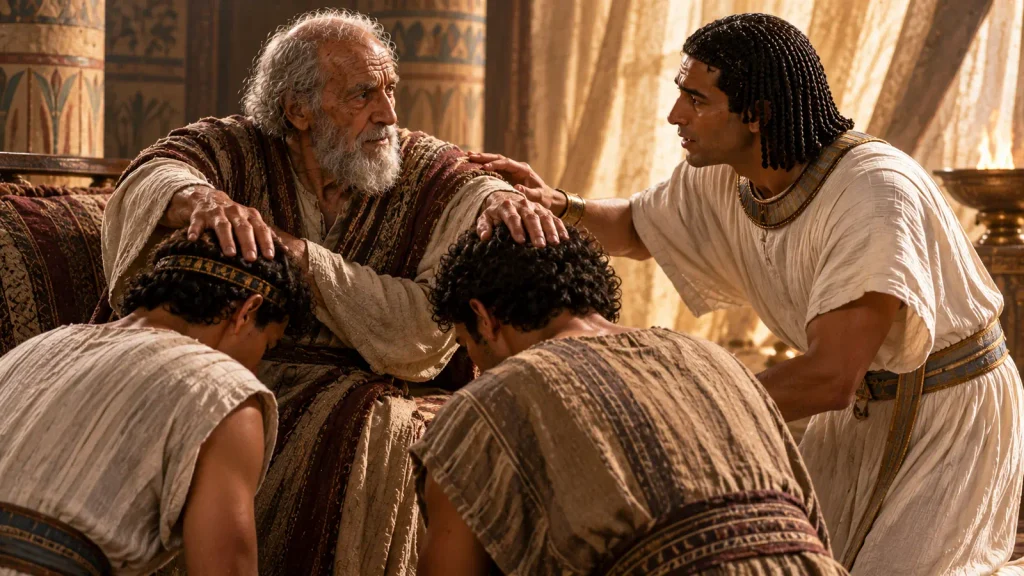
When Joseph hears that his father is ill, he brings Manasseh and Ephraim to him. The expected order appears obvious. Manasseh is Joseph’s firstborn, so Joseph positions him beside Jacob’s right hand. Ephraim, the younger son, stands beside Jacob’s left.
Jacob deliberately reverses the arrangement.
He reaches his right hand toward Ephraim. Joseph tries to correct him, but Jacob refuses: “I know, my son, I know.”
Why does Jacob place the younger son before the firstborn?
His own explanation is that Manasseh will become a people and will be great, but Ephraim will become greater and more numerous. Manasseh is not rejected; both sons are blessed. The crossed hands establish precedence, not acceptance for one and condemnation for the other.
Yet the chapter’s deepest alteration occurs before Jacob crosses his hands. He has already reckoned both Egyptian-born grandsons as his own sons, giving Joseph representation through two future tribal lines instead of one.
Jacob Begins With Bethel, Not With Birth Order
Joseph arrives with Ephraim and Manasseh, and the weakened patriarch gathers his strength to sit upright. Jacob does not begin by discussing which boy was born first. He begins with the God who appeared to him at Luz, later called Bethel.
Jacob recalls the promise of fruitfulness, multiplication, and land. God had promised that a community of peoples would come from him and that Canaan would belong to his descendants. That memory establishes the framework for everything that follows.
The blessing of Ephraim and Manasseh is therefore not a private display of grandfatherly affection. It concerns ancestry, inheritance, multiplication, and the future organization of Israel.
Ephraim and Manasseh Become Jacob’s Own
Jacob tells Joseph:
אֶפְרַיִם וּמְנַשֶּׁה כִּרְאוּבֵן וְשִׁמְעוֹן יִהְיוּ־לִי — ʾEphrayim ûMənaššeh kirʾûḇēn wəŠimʿôn yihyû-lî
“Ephraim and Manasseh will be mine, just as Reuben and Simeon are mine” (Genesis 48:5, NIV).
They remain Joseph’s biological sons, but Jacob now counts them alongside his own. The comparison with Reuben and Simeon is especially striking because they are Jacob’s two eldest sons. Ephraim and Manasseh will not function merely as descendants beneath Joseph’s single tribal name. Each will stand as a distinct branch within Israel.
Jacob adds that any children born to Joseph after them will remain Joseph’s and will receive their inheritance within the territories of Ephraim and Manasseh. The elevation is therefore specific to these two sons.
Joseph Receives Two Lines Instead of One
Normally, Joseph would represent one branch among Jacob’s sons. Genesis 48 creates a different arrangement: Ephraim and Manasseh each receive individual standing, and later territorial Israel will include both tribes.
This resembles a double inheritance for Joseph. Genesis 48 does not use the later legal expression “double portion,” so the terms should not be treated as identical without qualification. The practical effect within Israel’s tribal structure, however, is clear: Joseph receives representation through two sons where his brothers normally receive one.
That change must be distinguished from the second reversal in the chapter. First, Jacob elevates both of Joseph’s sons. Then he places Ephraim before Manasseh. One action concerns Joseph’s position among Jacob’s sons; the other concerns precedence within Joseph’s branch.
Why Joseph Expected Manasseh to Come First
Joseph’s objection is neither petty nor irrational. Manasseh is the firstborn, and firstborn status carried genuine familial and economic significance in the biblical world.
Deuteronomy 21:15–17 later protects the firstborn son’s right to a double share, even when his father prefers another wife. Ancient Near Eastern evidence also shows that elder sons could receive preferential treatment. Middle Assyrian Laws Tablet B, for example, describes an eldest son selecting and taking two shares when brothers divide their father’s estate.
The comparison provides useful context, but it should not be turned into a universal rule for every ancient household. Inheritance customs varied across periods and regions, and some legal traditions allowed fathers significant control over succession and distribution.
Joseph’s expectation nevertheless reflects a recognizable social order. He carefully places Manasseh toward Jacob’s right hand and Ephraim toward his left. The arrangement anticipates the firstborn receiving the position of precedence.
Jacob does the opposite.
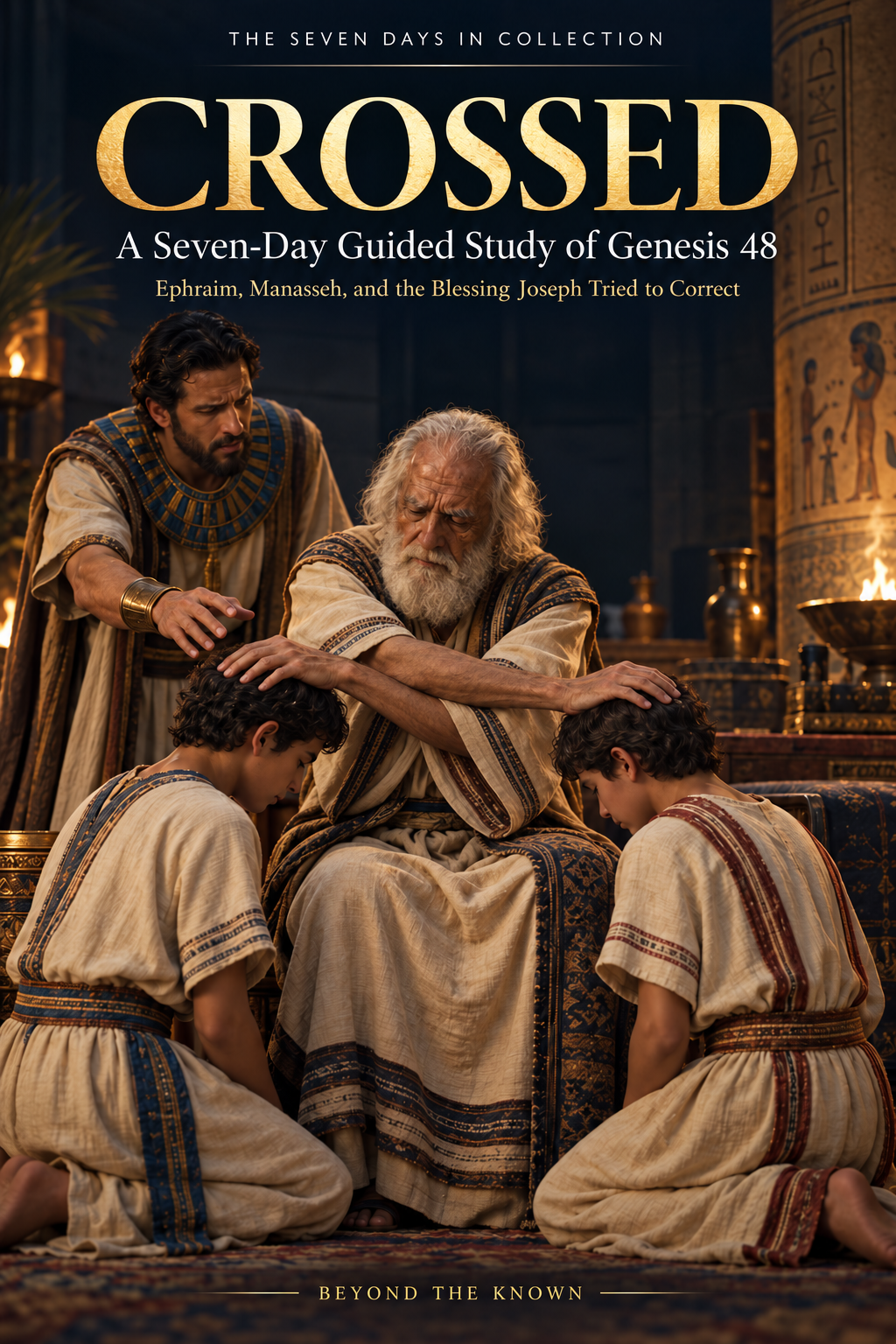
What Does “He Crossed His Hands” Mean?
Genesis 48:14 describes Jacob’s action with an unusual Hebrew expression:
שִׂכֵּל אֶת־יָדָיו — śikkēl ʾeṯ-yāḏāyw
Many modern translations render the phrase “he crossed his hands.” Older translations and interpreters have sometimes emphasized that Jacob acted knowingly, skillfully, or with deliberate insight. The verb belongs to the ś-k-l word family, which is commonly associated with understanding or prudent action.
The precise nuance of the verb remains debated, but the physical result is not. Jacob’s right hand rests on Ephraim, the younger son, while his left rests on Manasseh, the firstborn. Whether the verb itself depicts crossed arms or emphasizes intentional placement, the following dialogue removes the central uncertainty: Jacob knows which son is which.
Poor Eyesight Does Not Explain the Reversal
Genesis notes that Jacob’s eyes are failing with age. This creates the possibility that he has confused the grandsons, especially because an earlier generation’s blessing was shaped by an elderly father’s impaired vision.
Joseph seems to assume that a mistake has occurred. He takes Jacob’s hand and attempts to move it from Ephraim’s head to Manasseh’s. Jacob refuses and answers:
יָדַעְתִּי בְנִי יָדַעְתִּי — yāḏaʿtî ḇənî, yāḏaʿtî
“I know, my son, I know” (Genesis 48:19, NIV).
Jacob’s physical sight has weakened, but the narrative does not portray his decision as confusion.
Joseph Is Genuinely Displeased
Joseph’s reaction is stronger than mild surprise. Genesis says that what Jacob did was וַיֵּרַע בְּעֵינָיו — wayyēraʿ bəʿênāyw, literally something like “it was bad in his eyes.” English translations commonly render the expression “it displeased him.”
Joseph tells Jacob, “No, my father,” identifies Manasseh as the firstborn, and tries to redirect the right hand. He is not confused about either child’s identity. He believes that birth order should determine the placement.
The dispute is therefore precise: Joseph invokes firstborn priority, while Jacob announces a different future for the two sons.
Why Does Jacob Place Ephraim Before Manasseh?
Jacob’s answer begins by affirming Manasseh rather than dismissing him. The elder son will also become a people, and he too will be great. Only then does Jacob draw the distinction:
וְאוּלָם אָחִיו הַקָּטֹן יִגְדַּל מִמֶּנּוּ — wəʾûlām ʾāḥîw haqqāṭōn yiḡdal mimmennû
“Nevertheless, his younger brother will be greater than he” (Genesis 48:19, NIV).
Jacob continues by saying that Ephraim’s offspring will become מְלֹא־הַגּוֹיִם — məlōʾ-haggôyim, often translated “a group” or “multitude of nations.” The expression is unusual, and its exact scope deserves caution. The larger claim is easier to establish: Jacob predicts greater expansion and prominence for Ephraim.
That forecast is the reason Jacob gives Joseph. The text does not say that Manasseh is wicked, that Ephraim is morally superior, or that the elder son loses every blessing. Manasseh receives blessing; Ephraim receives precedence.
Does Genesis Say God Ordered Jacob to Choose Ephraim?
Not directly.
Jacob invokes God throughout the blessing. He remembers God’s promises, describes a lifetime of divine care, and asks for blessing upon the boys. Later biblical history also corresponds strongly with his words about Ephraim’s prominence.
Genesis 48, however, never records God saying, “Place Ephraim before Manasseh.” No new oracle appears within the scene. It is reasonable to read the reversal within Genesis’ wider pattern of unexpected election, but a specific unrecorded command should not be presented as though the narrator had disclosed it.
The most textually responsible conclusion is narrower: Jacob knowingly places Ephraim first because he declares that the younger son’s descendants will become more prominent.
Genesis Has Advanced Younger Sons Before
The reader has encountered disrupted birth order throughout Genesis. Ishmael is born before Isaac, yet the covenant line continues through Isaac. Esau is older than Jacob, yet Jacob becomes the bearer of the ancestral promise. Reuben is Jacob’s biological firstborn, but Genesis 35 and 49 connect his offense involving Bilhah with the loss of preeminence.
Now Manasseh stands before Ephraim, and ordinary sequence again fails to determine later status.
Roger Syrén describes this recurring feature as the “forsaken firstborn” motif in the patriarchal narratives. The individual stories are not identical, and the phrase can sound stronger than Genesis 48 itself because Manasseh remains blessed. Still, the recurring literary pattern is unmistakable: Genesis repeatedly prevents biological priority from functioning as an automatic guarantee of covenantal or tribal prominence.
Cain and Abel should be used more cautiously as a parallel. Cain is the firstborn and Abel’s offering receives divine regard, but Abel does not replace Cain through a formal inheritance reversal. Isaac and Ishmael, Jacob and Esau, Reuben and Joseph, and Ephraim and Manasseh provide closer comparisons.
Jacob’s Own History Makes the Scene Uncomfortable
The irony of Genesis 48 becomes sharper when placed beside Genesis 27. Jacob once stood on the younger side of a firstborn conflict. With Rebekah’s help, he disguised himself and deceived his visually impaired father in order to receive Isaac’s blessing.
Genesis 48 repeats several elements: another elderly father has failing eyesight, two descendants stand before him, and the expected order changes. Yet the decisive feature is reversed.
No one deceives Jacob. Joseph openly arranges the sons according to birth order, and Jacob openly changes that arrangement. When Joseph attempts to correct him, Jacob identifies his intention without hesitation.
In Genesis 27, Isaac’s blindness enables the deception because he cannot determine which son stands before him. In Genesis 48, Jacob’s failing vision creates suspense, but it does not control the outcome. The younger son who once deceived his blind father has become the blind father who insists that he knows exactly what he is doing.
The result is no longer obtained secretly. It is announced publicly and explained before Joseph.
The Blessing Reaches Beyond the Placement of Two Hands
Genesis 48:15 begins, “Then he blessed Joseph,” even though the words that follow concern Ephraim and Manasseh. Joseph receives the blessing through his sons, and his future continues through two descendants born far from Canaan.
Jacob invokes “the God before whom my fathers Abraham and Isaac walked,” then speaks of “the God who has been my shepherd all my life to this day” and “the Angel who has delivered me from all harm” (Genesis 48:15–16, NIV). Personal memory becomes intergenerational blessing.
“The God Who Has Been My Shepherd”
Jacob calls God:
הָאֱלֹהִים הָרֹעֶה אֹתִי — hāʾĕlōhîm hārōʿeh ʾōṯî
The image is especially fitting for a man who spent years tending Laban’s flocks. At the end of his life, Jacob interprets his own experience through the language of being shepherded.
That life included exile, family conflict, bereavement, famine, and unexpected reunion. The blessing does not emerge from an uncomplicated biography. It comes from a man looking back over a life that he believes God has sustained.
Ephraim and Manasseh Receive Jacob’s Name
Jacob asks that his name, and the names of Abraham and Isaac, be called upon the boys. The request reaches beyond affection for grandchildren. Ephraim and Manasseh are being placed within the ancestral line.
Their mother, Asenath, is Egyptian, and they were born in Egypt. Genesis does not treat that birthplace as an obstacle to their inclusion. Jacob locates their identity and future within his own house and within the promises associated with his fathers.
Is This an Ancient Adoption Ceremony?
Scholars often describe Genesis 48:5–6 as a form of adoption because Jacob counts Joseph’s sons as his own for purposes connected with lineage and inheritance. The comparison is useful, but the narrative never labels the act with a technical legal term.
Documents from the ancient Near East, including texts from Nuzi, show that adoption could affect household succession and property. Those documents provide historical context, not a direct script for Genesis 48. The Nuzi evidence is diverse, and legal historians have repeatedly warned against forcing scattered documents into a single “patriarchal custom.”
The safest conclusion comes from the biblical narrative itself: Jacob’s declaration gives two grandsons the standing of distinct ancestral branches within Israel.
Later Israel Makes Jacob’s Prediction Striking
Genesis does not leave Ephraim’s precedence hidden in body language. In the blessing formula of verse 20, Jacob names “Ephraim and Manasseh” in that order. The narrator then states explicitly that Jacob “put Ephraim ahead of Manasseh.”
Later biblical history makes the prediction especially significant. Joshua belongs to Ephraim. The tribe receives important territory in the central hill country, and Ephraim eventually becomes so prominent that prophets can use its name as a designation for the northern kingdom.
That later history should not be read backward as though Genesis 48 narrated events that had already occurred. Within the chapter, Jacob speaks about the future. Subsequent biblical texts provide the larger literary horizon in which his words are seen to correspond with Ephraim’s rise.
Manasseh does not disappear. It becomes a substantial tribe whose territory eventually extends on both sides of the Jordan. Jacob’s own words preserve this balance: Manasseh will become a people and will also be great.
Ephraim’s advancement does not require Manasseh’s destruction.
What Genesis 48 Does and Does Not Mean
Genesis 48 is sometimes reduced to an abstract lesson that “grace defeats works.” That theological theme may belong within wider Christian reflection, but it is not the immediate argument of the chapter.
The narrative concerns tribal origins, inheritance, ancestral blessing, and future prominence. Neither son is evaluated according to a record of moral achievement. Jacob does not say that Ephraim earned the right-hand blessing or that Manasseh lost it through misconduct.
Joseph is also not wrong about Manasseh’s identity. Manasseh truly is the firstborn, and Jacob does not dispute that fact. Their disagreement concerns what biological priority will determine. Joseph identifies the elder son; Jacob declares that the younger will become greater. Both statements can be true at the same time.
Finally, the chapter still points toward Canaan. After blessing the sons, Jacob tells Joseph that God will be with the family and bring them back to the land of their fathers. Ephraim and Manasseh were born in Egypt, but their future is connected with the ancestral land.
Genesis 47 looked toward Canaan through Jacob’s burial. Genesis 48 now looks toward the same land through his grandsons’ inheritance.
The Deeper Discovery
The most famous reversal in Genesis 48 is visible in Jacob’s crossed hands, but the deeper alteration happens first.
Before deciding which grandson will receive precedence, Jacob says, “Ephraim and Manasseh will be mine.” That declaration changes Joseph’s place within Israel’s future. One son of Jacob becomes represented through two tribal ancestors.
Genesis 48 therefore contains two distinct reversals. First, Joseph receives an exceptional share through the elevation of both sons. Second, the younger of those sons is placed ahead of the elder. When those actions are blended together, the architecture of the chapter disappears.
Jacob is not simply choosing Ephraim instead of Manasseh. He blesses both while assigning them different futures. Nor is he correcting a flaw in Manasseh or rewarding a virtue in Ephraim. The narrative presents an intentional reordering of expected status without erasing the elder son’s identity or blessing.
That leaves one final tension. Joseph saved the family from famine, receives representation through two tribal lines, and hears exceptional promises spoken over his sons. Readers might expect leadership over Israel to settle permanently within his branch.
Genesis 49 complicates that expectation. Reuben does not retain preeminence, but the language of rule, obedience, and the scepter does not pass to Joseph either. It goes to Judah, the brother who once proposed selling Joseph rather than killing him.
That is the next question in the story:
Why Does Jacob Give Judah the Royal Blessing Instead of Joseph?
Selected Sources
- Robert Alter, The Hebrew Bible: A Translation with Commentary. W. W. Norton, 2018.
- Eryl W. Davies, “The Inheritance of the First-Born in Israel and the Ancient Near East.” Journal of Semitic Studies 38.2 (1993): 175–191.
- Victor P. Hamilton, The Book of Genesis: Chapters 18–50. New International Commentary on the Old Testament. Eerdmans, 1995.
- Martha T. Roth, Law Collections from Mesopotamia and Asia Minor. 2nd ed. Writings from the Ancient World 6. Scholars Press, 1997.
- Nahum M. Sarna, Genesis. JPS Torah Commentary. Jewish Publication Society, 1989.
- Roger Syrén, The Forsaken First-Born: A Study of a Recurrent Motif in the Patriarchal Narratives. Journal for the Study of the Old Testament Supplement Series 133. JSOT Press, 1993.
- Gordon J. Wenham, Genesis 16–50. Word Biblical Commentary 2. Word Books, 1994.
- Raymond Westbrook, ed., A History of Ancient Near Eastern Law. 2 vols. Brill, 2003.