Why Doesn’t Isaac Take the Blessing Back?
Genesis 27 and the Moment a Deceptive Victory Becomes a Deliberate Succession
 |
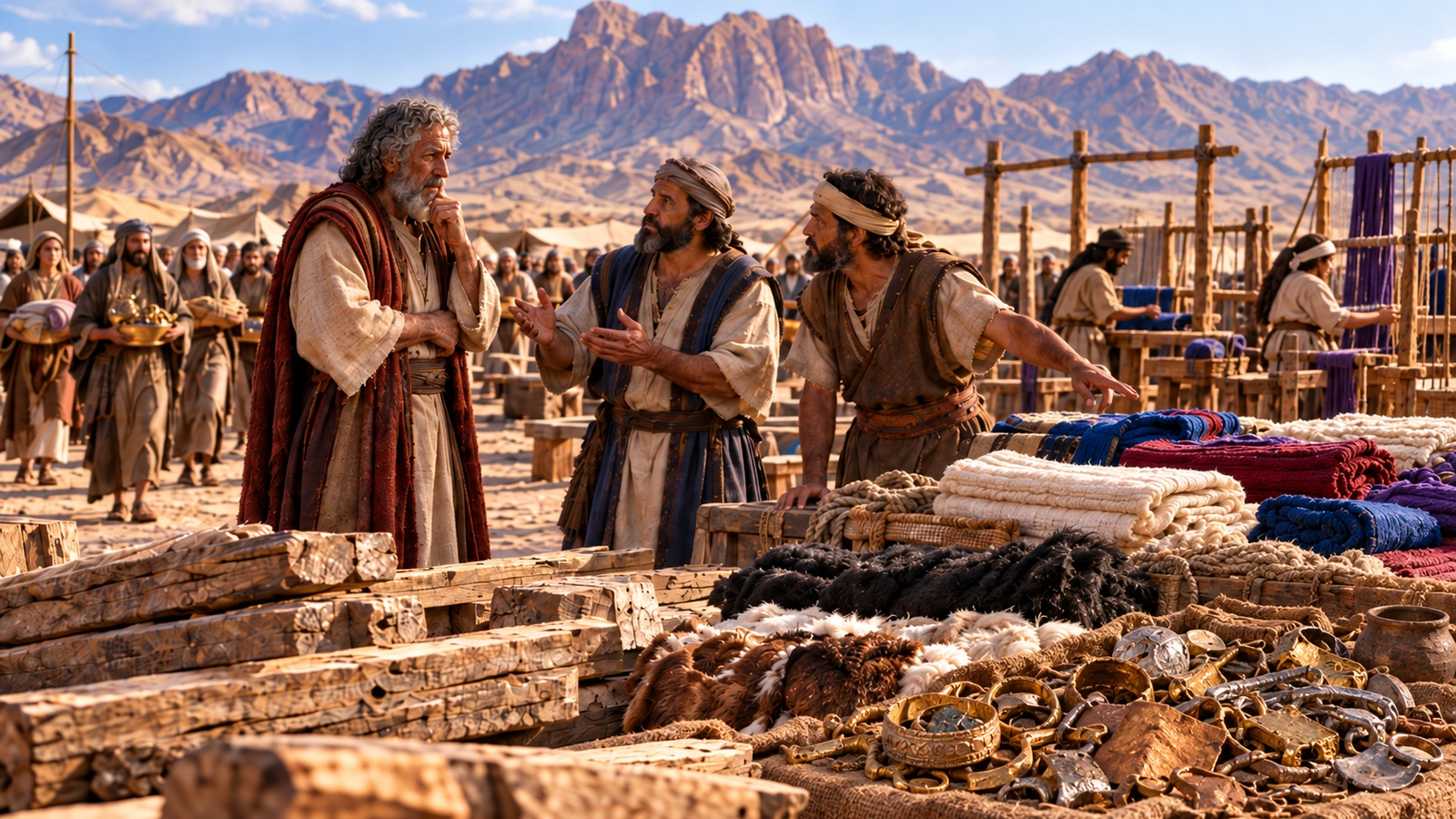
Figure 1. Artistic reconstruction of Isaac confronting the aftermath of Jacob’s deception as Esau returns with the prepared meal, representing the moment in Genesis 27 when the blessing is not withdrawn. |
The previous episode ended with disputed wells, renewed provision, and negotiated peace. That restraint was explored in Why Does Isaac Keep Walking Away from His Wells?
The next scene moves the struggle indoors. An aging father, failing eyesight, sibling rivalry, and a hidden plan now shape the household.
Readers enter with one earlier disclosure. Genesis 25:23 is commonly rendered, “the older shall serve the younger.”
One qualification matters immediately. Scripture never reports that Rebekah relayed that oracle to her husband.
A private conversation soon changes everything. Esau receives instructions to hunt, prepare food, and return for a paternal benediction.
His mother overhears the plan. She dresses Jacob in his brother’s garments and covers exposed skin with goat hides.
The younger twin then lies about his identity. Sensory tests nearly expose him before the deception succeeds.
Agricultural plenty, political supremacy, family authority, and curse protection reach the disguised recipient.
Minutes later, the hunter returns. What looked settled suddenly becomes a crisis.
Why does the patriarch not withdraw what he has just spoken?
The Most Important Reaction Comes After Discovery
Genesis 27:33 uses unusually intense language when the truth surfaces:
וַיֶּחֱרַד יִצְחָק חֲרָדָה גְּדֹלָה עַד־מְאֹד — wayyeḥĕrad Yiṣḥāq ḥărādâ gədōlâ ʿad-məʾōd
The Hebrew combines a verb with a related noun. Its force portrays extreme trembling, not mild surprise.
Nothing in that clause identifies the emotion’s cause. Fear, anger, recognition, or theological submission remain interpretive proposals.
What follows is firmer:
גַּם־בָּרוּךְ יִהְיֶה — gam-bārûḵ yihyeh
The clause is commonly rendered, “Yes, he shall be blessed.” Discovery does not produce cancellation.
That short statement redirects the entire scene. The question is no longer whether fraud occurred.
According to verse 35, the brother came בְּמִרְמָה — bəmirmâ, “with deception” or “with guile.”
The method is not morally neutralized. The deceived parent himself labels it mirmâ.
Birthright and Blessing Are Not the Same Thing
Modern retellings often merge two episodes. Biblical Hebrew keeps their key terms distinct.
Genesis 25 uses בְּכֹרָה — bəkhorâ for “birthright.” Chapter 27 repeatedly uses בְּרָכָה — bərāḵâ for the paternal pronouncement.
Esau himself separates them in verse 36. He says Jacob took the earlier privilege and now his benediction.
The distinction prevents an easy shortcut. Selling the earlier privilege does not explain every feature of the later scene.
Both episodes concern status within one household. Still, the vocabulary refuses to make them identical.
Does Genesis Say a Blessing Was Legally Irrevocable?
A popular explanation appeals to an ancient rule. Once a father spoke such words, the claim says, nobody could revoke them.
Genesis never states that universal principle. No legal formula appears explaining why reversal would be impossible.
Verse 37 offers something more concrete. The speaker lists what he has already assigned to the disguised son.
Mastery over relatives has been granted. Grain and wine have also been provided within the spoken allocation.
Esau responds by asking whether another benediction remains. His anguish shows the first grant carries enormous weight.
Yet additional speech remains possible. Verses 39–40 describe another future involving sword, service, and eventual release.
So the issue cannot be reduced to magical syllables. A second destiny can still be articulated.
Why Can’t the Older Son Receive the Same Pronouncement?
The content already given creates a practical contradiction. Verse 29 placed the recipient above his brothers.
Later, the father explains that he has made Jacob Esau’s master. Repeating identical supremacy language would reverse that arrangement.
This is why verse 37 matters more than a vague rule. The speaker asks, “What then can I do for you, my son?”
The older twin still pleads for something separate. His cry in verse 38 rejects generic paternal goodwill.
Another oracle follows, but its content differs. It addresses habitation, violence, subordination, and eventual release.
The scene presents differentiated destinies. Two sons can receive words, but not the same assigned position.
A Real Ancient Parallel—Without Making It Prove Too Much
Second-millennium Mesopotamian documents show that succession was treated formally. Assyrian wills and Babylonian estate records assigned property among heirs.
Northern archives also preserve preferential treatment for eldest sons. Double-share practices appear across several regional legal traditions.
Those records do not prove that Genesis 27 follows one identical mechanism. Neither do they establish automatic irrevocability for every paternal utterance.
Older comparisons with Nuzi sometimes pressed similarities too far. Comparative work requires attention to differences across periods and regions.
Historical context can explain why succession mattered intensely. The biblical passage must still supply its own answer.
What Did Jacob Actually Receive?
Verses 28–29 promise dew, fertile soil, grain, wine, international submission, and dominance over brothers.
A closing curse-and-bless formula recalls language associated with Abraham. That resemblance makes a covenantal reading understandable.
However, the passage never labels this first speech “the blessing of Abraham.” Precision matters here.
The explicit phrase appears one chapter later. Its placement changes the entire investigation.
Before reaching that moment, another earlier text must be considered. The prenatal oracle had already placed the twins within a reversed hierarchy.
Most English translations render its final line, “the older shall serve the younger.” Readers possess information unavailable to several characters.
No verse says the father heard that revelation. Claiming conscious rebellion against it would exceed the evidence.
His preference for Esau is explicit. Awareness of Rebekah’s message is not.
This creates narrative irony. Deception produces an outcome resembling a future announced before either son was born.
Isaac’s Tests Make the Mistaken Identity Harder to Ignore
The disguised visitor does not pass unnoticed. Voice, timing, touch, clothing, and smell all become evidence.
Sarah Schwartz has shown how the repeated testing forms a deliberate parallel structure. Hair and field-scent finally outweigh vocal suspicion.
That literary design matters because the error is not casual. Recognition almost occurs before the decisive speech.
When truth finally arrives, the old man understands exactly how thoroughly he was deceived.
His next response carries greater force for that reason. “He shall be blessed” follows full recognition, not continued confusion.
Genesis 28 Provides the Strongest Answer
Chapter divisions can hide the decisive evidence. The next unit opens with Jacob summoned openly by his father.
No costume remains. Nobody mistakes one brother for another.
A fresh benediction accompanies instructions about marriage. Then the wording becomes unmistakably ancestral.
Genesis 28:3 invokes אֵל שַׁדַּי — ʾĒl Šadday, fruitfulness, multiplication, and an assembly of peoples.
Verse 4 then gives:
בִּרְכַּת אַבְרָהָם — birkat ʾAḇrāhām
“the blessing of Abraham.”
Land and descendants now accompany that explicit formulation. The recipient stands before his father under his real identity.
That phrase was absent from the stolen speech. Here it is knowingly directed toward the younger son.
The second act changes how chapter 27 should be read. Failure to cancel becomes deliberate confirmation.
Elizabeth Boase likewise identifies Isaac as an important link transmitting ancestral promises toward Jacob and later generations.
What Can We Say with Confidence?
The textual sequence establishes several points without speculation. Jacob lies, receives the intended words, departs, and is exposed.
Afterward, verse 33 leaves the earlier declaration standing. Verse 37 treats its allocations as already granted.
A different future is then spoken over Esau. Genesis 28 later transfers Abrahamic continuity knowingly toward the younger brother.
These details do not require a theory of automatic verbal magic. They arise from the sequence itself.
One strong inference follows. The first event begins through deception, but succession does not remain dependent on mistaken identity.
A fully informed parent subsequently confirms the heir’s place within Abraham’s line.
The Deeper Discovery
The original mystery asks why the stolen words are not revoked. Genesis gives no abstract rule explaining their permanence.
Its stronger literary answer appears after the fraud is exposed.
What happened unknowingly is later affirmed knowingly.
That distinction transforms the episode. Jacob leaves home carrying more than an advantage obtained through disguise.
Before departure, Abrahamic continuity is deliberately placed upon him. The ancestral future no longer rests on sensory error.
The account also refuses to sanitize the means. Deceit fractures the household and turns Esau toward murder.
Flight now becomes necessary. The recipient of the promises leaves the territory he is expected to inherit.
Chapter 28 places him alone beneath the night sky. A stone becomes associated with a place he will name Bethel.
The famous dream receives enormous attention from readers. Yet that scene also emphasizes location, naming, pillar, oil, vow, and return.
That creates the next question:
Why Does Genesis Spend More Time on Bethel Than on Jacob’s Dream?
Selected Sources
Boase, Elizabeth. “Life in the Shadows: The Role and Function of Isaac in Genesis—Diachronic and Synchronic Readings.” Vetus Testamentum 51.3 (2001): 312–335.
Hamilton, Victor P. The Book of Genesis: Chapters 18–50. Eerdmans.
Mathews, Kenneth A. Genesis 11:27–50:26. New American Commentary. B&H.
Sarna, Nahum M. Genesis. JPS Torah Commentary.
Schwartz, Sarah. “Isaac’s Dual Test in the Blessings Narrative: A New Reading of Gen 27:18–29.” JSOT 43.4 (2019): 693–711. DOI: 10.1177/0309089218786098.
Wenham, Gordon J. Genesis 16–50. Word Biblical Commentary.