Why Does God Tell Jacob, “Do Not Be Afraid to Go Down to Egypt ?
Genesis 46 Explained: Beersheba, Jacob’s Night Vision, the Seventy, and Why Egypt Does Not Cancel the Promise
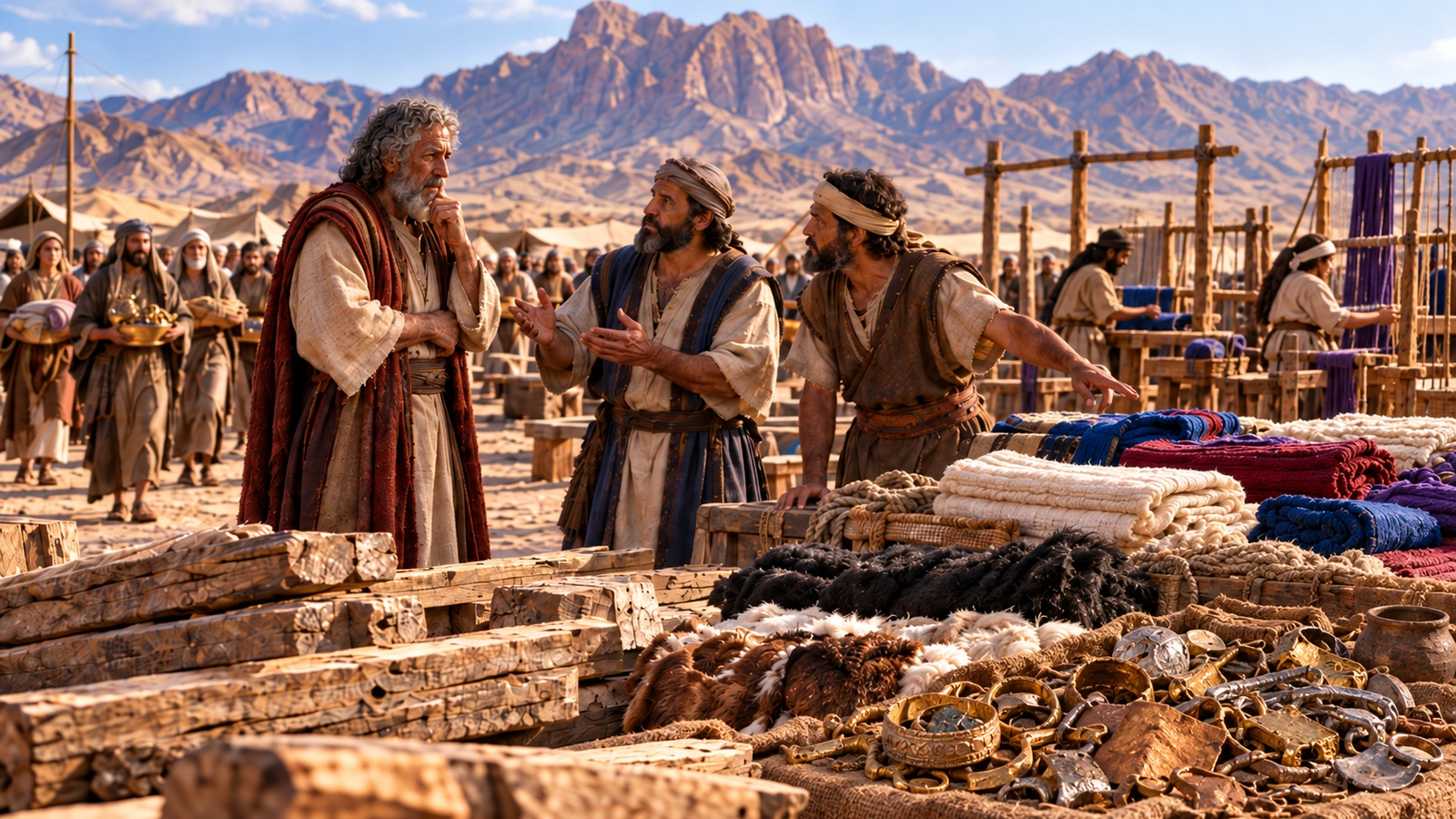
Figure 1. Artistic reconstruction of the elderly Jacob at Beersheba beside a stone altar at night, with his extended household preparing to journey toward Egypt, representing Genesis 46:1–4 and the moment God tells him not to fear the descent.
Source: AI-generated image created for Beyond The Known.

Figure 1. Artistic reconstruction of the elderly Jacob at Beersheba beside a stone altar at night, with his extended household preparing to journey toward Egypt, representing Genesis 46:1–4 and the moment God tells him not to fear the descent.
Source: AI-generated image created for Beyond The Known.
Why Does Joseph Say, “It Was Not You Who Sent Me Here, But God”? ended with one startling interpretation.
Joseph had not merely survived Egypt.
He believed God had sent him ahead to preserve life.
That answer creates a new problem.
If Joseph was sent ahead, Jacob must now follow.
Yet the patriarch is leaving Canaan with his entire household.
Abraham once entered Egypt during famine and encountered disaster.
Isaac later received an explicit warning not to descend there.
Now Jacob approaches the same country carrying Abraham’s descendants with him.
Before continuing south, he stops at Beersheba.
There, during the night, God addresses his fear:
“Do not be afraid to go down to Egypt.”
Why would Jacob need that reassurance?
The answer reaches beyond an elderly father anxious about travel.
Genesis is about to move Abraham’s entire family outside the promised land.
God must explain what that descent means.
Jacob Does Not Travel Directly to Egypt
Genesis 45 ended with urgency.
Joseph told his brothers to bring Jacob quickly.
Pharaoh supplied wagons.
The famine still had five years remaining.
Jacob could simply have traveled south.
Instead, Genesis 46 pauses at Beersheba.
Israel arrives there with everything belonging to him.
Then he sacrifices:
לֵאלֹהֵי אָבִיו יִצְחָק — lēʾlōhê ʾāḇîw Yiṣḥāq
“to the God of his father Isaac.”
The wording deserves attention.
Genesis does not merely call him “the God of Abraham.”
Here Isaac is specifically named.
That choice connects Jacob’s departure with his father’s experience.
Beersheba Carries Isaac’s History
Beersheba already holds important memories within Genesis.
Abraham had worshiped there.
Isaac later came to the same region.
At Beersheba, YHWH appeared to Isaac and reaffirmed the ancestral promise.
Isaac built an altar there afterward.
That background makes Jacob’s stop significant.
Still, Genesis never tells us his private reason for choosing the site.
We should not claim that he deliberately sought divine permission.
What the narrator gives us is sequence.
Jacob reaches Beersheba.
He sacrifices.
God speaks that night.
Isaac Had Been Told Not to Enter Egypt
The connection becomes sharper when Genesis 26 is remembered.
Another famine once threatened the land.
Isaac apparently moved toward the territory controlled by Abimelech.
God then told him:
“Do not go down to Egypt.”
Isaac remained within Canaan.
Jacob now faces the opposite situation.
His household is moving toward the country his father was forbidden to enter.
Genesis never says Jacob was mentally comparing both episodes.
Yet readers can.
The contrast makes the divine reassurance in chapter 46 especially important.
God Speaks “In Visions of the Night”
Genesis describes the revelation as:
בְּמַרְאֹת הַלַּיְלָה — bəmarʾōṯ hallaylāh
“in visions of the night.”
Then God calls:
“Jacob, Jacob.”
The patriarch answers:
הִנֵּנִי — hinnēnî
“Here I am.”
The doubled name gives the address unusual intensity.
Genesis uses a similar repetition when the angel calls “Abraham, Abraham” in chapter 22.
Later biblical narratives use comparable forms at decisive moments.
Here the call occurs at a geographical threshold.
Jacob’s family is about to leave Canaan together.
“Do Not Be Afraid” Does Not Tell Us Why He Was Afraid
God says:
אַל־תִּירָא מֵרְדָה מִצְרַיְמָה — ʾal-tîrāʾ mērdāh Miṣraymāh
“Do not be afraid to go down to Egypt.”
The text confirms fear.
It never identifies its exact cause.
That distinction eliminates several common overstatements.
Perhaps Jacob remembered Isaac’s prohibition.
He may have understood the danger of leaving Canaan.
Abraham’s earlier Egyptian crisis also stood within family history.
Genesis 15 had warned that Abraham’s descendants would become strangers in another land.
Any of these associations may illuminate the scene.
None is explicitly named as Jacob’s thought.
God Does Not Grammatically Command, “Go Down”
This point deserves precision.
Genesis 46:3 is often paraphrased:
“God commanded Jacob to go to Egypt.”
The Hebrew is more restrained.
The command is:
אַל־תִּירָא — ʾal-tîrāʾ
“Do not fear.”
What follows specifies the feared action:
מֵרְדָה מִצְרַיְמָה — mērdāh Miṣraymāh
“to go down to Egypt.”
God unmistakably authorizes and reassures the migration.
Yet the sentence is not simply an imperative meaning “Go to Egypt.”
That difference matters.
Jacob had already decided to see Joseph.
Divine speech now explains why that journey need not threaten the ancestral promise.
The Answer Begins With God’s Identity
Before explaining Egypt, God identifies himself:
אָנֹכִי הָאֵל אֱלֹהֵי אָבִיךָ — ʾānōḵî hāʾēl ʾĕlōhê ʾāḇîḵā
“I am God, the God of your father.”
Again, Isaac stands behind the scene.
The deity who remained faithful to Jacob’s father now speaks at the edge of another migration.
Geography is about to change.
The speaker has not.
That continuity becomes the foundation for everything following.
Egypt Is Where the Family Will Become a Nation
God next says:
לְגוֹי גָּדוֹל אֲשִׂימְךָ שָׁם — ləgôy gāḏôl ʾăśîmḵā šām
“There I will make you into a great nation.”
One word carries enormous weight:
שָׁם — šām
“there.”
Not merely someday.
Not somewhere unspecified.
There.
In Egypt.
The promise made to Abraham in Genesis 12:2 now receives unexpected geography.
Abraham was promised a great nation.
Jacob learns that Egypt will become the setting for that demographic transformation.
Leaving Canaan Does Not Cancel Canaan
The older article risked making the land almost secondary.
Genesis does not.
Canaan remains promised territory.
Later chapters will make burial there extremely important.
Joseph himself eventually demands that his bones leave Egypt.
Divine presence outside Canaan does not erase the land promise.
Instead, chapter 46 introduces another truth.
The fulfillment can temporarily develop outside the territory ultimately promised to Abraham’s descendants.
That tension will shape the rest of the Pentateuch.
“I Myself Will Go Down With You”
God then says:
אָנֹכִי אֵרֵד עִמְּךָ מִצְרַיְמָה — ʾānōḵî ʾērēḏ ʿimməḵā Miṣraymāh
“I myself will go down with you to Egypt.”
The repeated first-person pronoun gives the clause emphasis.
Jacob is not promised a safe location.
He is promised divine accompaniment.
That difference is central.
Egypt will eventually become dangerous.
Genesis already knows that.
The assurance does not depend upon the country remaining hospitable.
It depends upon God accompanying the family there.
Then God Promises an Ascent
The next clause reverses the movement:
וְאָנֹכִי אַעַלְךָ גַם־עָלֹה — wəʾānōḵî ʾaʿalḵā gam-ʿālōh
“And I myself will surely bring you up again.”
The language is emphatic.
Jacob goes down.
God goes down with him.
Then God promises to bring him up.
The geography is already becoming theology.
Descent will not be the final movement.
But Jacob Never Returns Alive
That creates an immediate interpretive difficulty.
Jacob dies in Egypt.
Genesis 49 records his death there.
Genesis 50 describes his burial in Canaan.
So what does:
“I will bring you up again”
mean?
Two major readings deserve attention.
One understands the promise personally.
Jacob’s remains will be carried from Egypt to the family burial place.
Another sees Jacob corporately, representing the descendants who will later leave Egypt.
Both ideas eventually appear in Genesis.
Neither should be dismissed too quickly.
The Next Sentence Prevents a Simple Reading
God immediately adds:
“Joseph will place his hand upon your eyes.”
The traditional sense concerns Joseph being present at Jacob’s death.
That detail makes one point unavoidable.
God is not promising that Jacob will personally escape death in Egypt.
The patriarch will reach Joseph.
His son will be there at life’s end.
Then some form of “bringing up” still lies beyond that death.
This allows both burial and the future return of his descendants to resonate within the promise.
Genesis 50 Will Fulfill Both Patterns
Jacob’s body is eventually taken to Canaan.
His descendants remain behind.
Near the book’s end, Joseph announces another future movement:
God will visit them.
They will be brought from Egypt to the land promised to Abraham, Isaac, and Jacob.
Joseph then binds Israel to carry his bones during that future departure.
Genesis 46 therefore opens a descent-and-return structure.
Genesis 50 refuses to let readers forget it.
Exodus will inherit that unfinished movement.
Why Does Genesis Suddenly List So Many Names?
After the night vision, the narrative slows dramatically.
Reuben appears.
Then Simeon.
Levi.
Judah.
The remaining sons follow with descendants.
Modern readers often treat this genealogy as interruption.
Within the chapter, it performs a more important function.
God has just promised:
“I will make you into a great nation there.”
The genealogy identifies the household entering the place where that expansion will occur.
These names form the starting population.
Sixty-Six Become Seventy
Genesis 46:26 gives one number:
sixty-six.
These are Jacob’s direct descendants traveling with him, excluding his sons’ wives.
Joseph and his sons are already in Egypt.
The next verse counts the entire household differently.
The Masoretic Hebrew tradition gives:
seventy.
Jacob, Joseph, Manasseh, and Ephraim complete that larger total.
The two figures answer different counting questions rather than functioning as simple duplicates.
Why Does the Septuagint Say Seventy-Five?
An important textual variation appears here.
The Greek Septuagint preserves additional descendants connected with Joseph.
Its total becomes:
seventy-five.
Acts 7:14 follows that Greek numerical tradition.
This is not something modern translators invented.
It reflects an ancient textual difference in how Joseph’s descendants were counted.
The Masoretic tradition preserves seventy.
The Greek form preserves seventy-five.
For Genesis 46, the theological movement does not depend upon choosing a symbolic solution.
A household enters Egypt.
A nation will eventually emerge.
Archaeology Shows That Levantines Really Lived in the Eastern Delta
Genesis later places Jacob’s family in the Egyptian Delta.
Archaeology offers an important historical parallel.
Tell el-Dabʿa, ancient Avaris, stood in the eastern Nile Delta.
During the late Middle Kingdom, the settlement became an important harbor and trade center.
Excavations have uncovered Levantine imports and cultural connections there.
Metropolitan Museum research also notes that part of the region’s population during Dynasty 13 was of Levantine origin.
That evidence matters.
People from Canaan and neighboring regions could migrate, trade, and live inside northeastern Egypt.
Tell el-Dabʿa Is Not Jacob’s House
The archaeological evidence must not be pushed farther.
No inscription from Avaris says:
“Jacob lived here.”
No excavated dwelling identifies Joseph’s brothers.
Neither can Tell el-Dabʿa establish a precise patriarchal chronology.
The site supplies historical context.
It shows a real eastern Delta world containing Egyptian and Levantine interaction.
That makes the social setting plausible.
It does not verify the biblical family.
The Material Record Reveals a Mixed Frontier
Late Middle Kingdom remains at Tell el-Dabʿa include ordinary mudbrick houses.
Excavators also found grain silos, hearths, workshops, pottery, and imported Levantine ceramics.
The site was not merely a royal monument.
It contained lived communities embedded within long-distance trade networks.
That picture matters for Genesis.
Jacob’s migration does not require imagining Egypt as culturally sealed from Canaan.
Movement across the northeastern frontier belonged to the ancient world.
Judah Now Leads the Family Toward Joseph
After the genealogy, Jacob sends Judah ahead.
That detail continues Judah’s remarkable narrative rise.
Genesis 43 made him responsible for Benjamin.
Chapter 44 gave him the decisive appeal before Joseph.
Now Jacob entrusts him with moving ahead toward Goshen.
Joseph prepares his chariot.
The father and son finally meet.
Genesis Gives Almost No Speech to Joseph at the Reunion
Joseph appears before Jacob.
He falls upon his father’s neck.
Then he weeps for a long time.
The narrator gives Jacob the spoken response:
“Now I can die, since I have seen your face.”
For decades, Jacob believed Joseph was gone.
Gênesis does not turn the reunion into a long conversation.
Physical recognition is enough.
The lost son is alive.
Yet the story immediately turns toward settlement.
Why Does Joseph Emphasize Their Occupation?
Joseph tells his family how to speak before Pharaoh.
They should explain that they work with livestock.
His goal is connected with Goshen.
Genesis then adds:
תּוֹעֲבַת מִצְרַיִם כָּל־רֹעֵה צֹאן — tôʿăḇaṯ Miṣrayim kol-rōʿēh ṣōʾn
“Every shepherd of sheep is an abomination to Egyptians.”
The historical explanation is difficult.
Egyptians themselves kept livestock.
Pharaoh even possesses herds in the following chapter.
We should not claim that Egyptian civilization universally despised animal husbandry.
The “Abomination” Has No Simple Archaeological Explanation
Several theories have been proposed.
Some connect the statement with social prejudice toward pastoral groups.
Others emphasize tensions involving mobile Asiatic populations along Egypt’s northeastern frontier.
Religious or occupational explanations have also appeared.
No consensus securely explains the biblical wording.
A peer-reviewed study by Aron Pinker argues that many traditional explanations remain inadequate and offers its own contextual proposal cautiously.
The uncertainty should remain visible.
Genesis itself is more interested in the result.
Their occupation helps place them in Goshen.
Does Goshen Preserve Israel’s Identity?
That is a common theological reading.
It is plausible.
Separate settlement could reduce cultural assimilation.
Later narrative developments make distinct identity increasingly important.
Genesis 46 does not explicitly say Joseph’s plan exists for that purpose.
His stated concern is securing residence in Goshen.
Anything beyond that belongs to literary or theological inference.
We gain nothing by converting a reasonable implication into a quotation the narrator never gives.
Egypt Begins as Refuge, Not Slavery
Readers who know Exodus encounter a strange tension.
Egypt will become the house of bondage.
Genesis 46 does not depict that Egypt yet.
Joseph is powerful.
Pharaoh is favorable.
Food is available.
Jacob’s household receives protection during famine.
The later oppression should not be projected backward onto every Egyptian scene.
That transformation requires another king.
Exodus 1 will announce him with ominous precision.
The Promise Is Larger Than Immediate Safety
God never tells Jacob:
“Nothing painful will happen in Egypt.”
That promise would prove false.
Neither does he say the family will remain there permanently.
Instead, four assurances frame the migration.
Jacob need not fear the descent.
A great nation will arise there.
Divine presence will accompany him.
An ascent will follow.
Those statements redefine the risk without denying it.
The Deeper Discovery
The most revealing feature of Genesis 46 may be hidden in its verbs of movement.
God first addresses Jacob’s fear of:
מֵרְדָה — mērdāh
“going down.”
Then he says:
אֵרֵד — ʾērēḏ
“I will go down.”
Finally comes:
אַעַלְךָ — ʾaʿalḵā
“I will bring you up.”
Jacob’s descent becomes a descent God shares.
The promised ascent belongs to God’s action as well.
That sequence changes the entire chapter.
The assurance is not:
Egypt is harmless.
Nor is it:
Canaan no longer matters.
The promise is more demanding.
Jacob can leave the promised land because departure will not sever divine presence.
He can enter Egypt because Egypt cannot become the final destination.
God identifies the place of exile as the place of multiplication.
Then he places return inside the same sentence as descent.
The journey south therefore contains an unfinished direction from its beginning.
Down is followed by up before Jacob has traveled another mile.
That is why he does not need to fear.
His family’s geographical reversal is not the cancellation of Abraham’s future.
Egypt becomes one stage within it.
Yet the promise creates one final irony.
Jacob knows God has pledged to bring him—or what he represents—back up.
He will still die on Egyptian soil.
Near the end of his life, he calls Joseph to his bedside.
Then he demands an oath.
Whatever prosperity Egypt offers, Jacob refuses to let Egypt become his permanent resting place.
Why Does Jacob Refuse to Be Buried in Egypt?
Selected Sources
- Gordon J. Wenham, Genesis 16–50, Word Biblical Commentary.
- Victor P. Hamilton, The Book of Genesis: Chapters 18–50, Eerdmans.
- Nahum M. Sarna, The JPS Torah Commentary: Genesis, Jewish Publication Society.
- Robert Alter, The Hebrew Bible: A Translation with Commentary, W. W. Norton.
- Claus Westermann, Genesis 37–50: A Commentary.
- Manfred Bietak, Avaris, the Capital of the Hyksos: Recent Excavations at Tell el-Dabʿa, British Museum Press.
- Austrian Archaeological Institute, research and excavations at Tell el-Dabʿa/Avaris, including the late Middle Kingdom settlement and harbor.
- Aron Pinker, “‘Abomination to Egyptians’ in Genesis 43:32, 46:34, and Exodus 8:22,” Old Testament Essays 22.1 (2009): 151–174.