Why Does Jacob Retell His Story Before Leaving Laban?
Genesis 31:4–16 and the Speech That Reinterprets Twenty Years Before the Journey Home
 |
|
Genesis 30 ended with a puzzle about agency. Why Does Genesis 30 Keep Redirecting the Outcome Back to God? on July 14, 2026 showed how fertility and wealth resist simple explanations based on human technique.
Chapter 31 opens under pressure. Laban’s sons accuse their relative of taking their father’s wealth, while the older man’s attitude has visibly changed.
Then YHWH commands a return to ancestral territory and promises continued presence. The road toward Canaan appears ready to begin.
Departure does not happen yet. Rachel and Leah are summoned to the field, where a long explanation precedes every packed camel.
Why place this retrospective speech between divine command and actual flight?
The answer is larger than “Jacob needed permission.” His account reinterprets prosperity, exposes conflict, recalls Bethel, and invites his wives to choose where their allegiance now lies.
The Setting Turns a Command Into a Family Decision
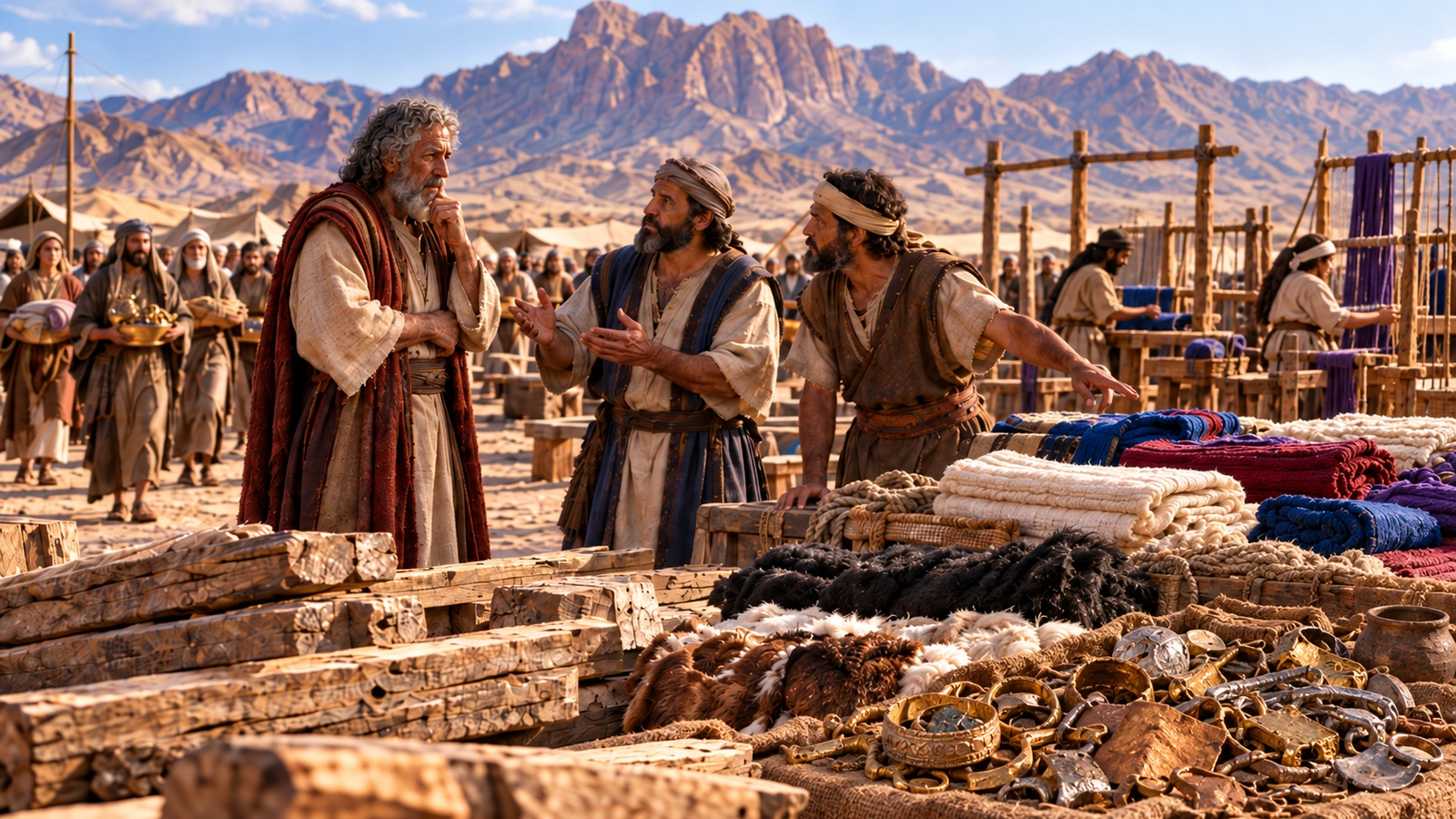
Verse 4 places the conversation “in the field” beside the flock. Genesis gives the location but never explains why that setting was chosen.
Older commentators often infer privacy because the meeting occurs away from Laban’s household. That possibility is reasonable, yet the narrator does not explicitly say secrecy motivated the choice.
What matters textually is who must hear the case. The returning migrant will not travel alone; two daughters, children, servants, and extensive property must cross the Euphrates with him.
A divine instruction received by one man becomes a household decision. Before the caravan moves, those most affected receive an interpretation of the past and a reason for leaving.
Laban’s Face Has Changed
The address begins with visible danger rather than theology.
“I see your father’s face,” the husband says, “that it is not toward me as before.”
Hebrew פְּנֵי לָבָן — pənê Lāḇān refers literally to Laban’s “face” or “countenance.” In context, the expression describes altered disposition.
That observation matches the accusations heard in verse 1. Hostility now comes from both the sons’ words and the patriarch’s demeanor.
Only after establishing this threat does the speaker add another claim:
“The God of my father has been with me.”
Social danger is real, but it does not become the controlling explanation.
The Retelling Is Selective, Not Neutral
Rachel and Leah already know years of service occurred. Their husband nevertheless reminds them that he worked with all his strength.
Next comes an accusation: their father repeatedly changed his wages.
Genesis 31:7 uses:
עֲשֶׂרֶת מֹנִים — ʿăśeret mōnîm
The phrase is conventionally rendered “ten times.”
Previous chapters never narrate ten separate renegotiations. Many commentators consequently understand the number as emphatic rather than a documented ledger of exactly ten alterations.
More important is the contrast attached to that complaint.
The employer alters terms.
Elohim prevents harm.
Economic conflict is retold inside a theological frame.
The Flocks Sound Different When Jacob Tells the Story
Chapter 30 described peeled branches, watering troughs, selective pairing, and stronger animals.
None of those details appears in the speech to the wives.
Instead, the shepherd says that whenever one coat pattern became his wage, the animals produced that pattern.
He then concludes that God transferred livestock from their father to him.
That omission is striking.
The earlier narration foregrounded technique.
By contrast, the later recollection foregrounds divine intervention.
Genesis has not erased the rods.
It has placed a second explanation beside the first.
A Dream Appears That Readers Had Not Previously Seen
Verses 10–12 introduce another surprise.
During breeding season, the speaker says he saw patterned males mounting the flock in a dream.
A divine messenger then declares:
“I have seen all that Laban is doing to you.”
Chapter 30 never narrated this vision.
That gap has produced genuine scholarly disagreement.
Some commentators treat Genesis 31 as supplying information omitted earlier.
Others understand the recollection as rhetorically shaped testimony.
Source-oriented approaches have explained the differences through compositional history.
Émine Salman and André Wénin press the rhetorical reading further. They argue that the dream may function as Jacob’s persuasive construction rather than a neutral flashback.
Their proposal should not be converted into fact.
The narrator never explicitly declares the vision fabricated.
What can be observed is simpler.
The character’s version turns livestock increase into evidence that heaven saw Laban’s conduct.
Bethel Changes the Meaning of Leaving
The recollected vision does not end with animals.
Its speaker identifies himself as:
אָנֹכִי הָאֵל בֵּית־אֵל — ʾānōḵî hāʾēl Bêt-ʾĒl
“I am the God of Bethel.”
That identification reaches back across roughly two decades of narrative time.
At Bethel, the fugitive had raised a pillar, poured oil upon it, and made a vow.
The same location also carried promises of protection and eventual return.
Genesis 31:13 explicitly recalls the monument and commitment.
The command “leave this land and return” is not presented as a sudden escape plan.
It reconnects the present crisis with an unfinished journey that began before Haran.
The Past Is Being Organized Around a Promise
This retelling now becomes more than autobiography.
Marriage, wages, livestock, exploitation, and revelation are gathered under one trajectory:
return.
Events that once seemed disconnected acquire direction.
The speaker does not deny labor or conflict.
He arranges both beneath a larger claim of preservation.
That rhetorical move matters because Rachel and Leah must decide whether to remain within their father’s world.
Following their husband means leaving that social structure behind.
The Wives Do Not Simply Say “Yes”
Their reply begins with inheritance.
“Do we still have any share or inheritance in our father’s house?”
Two Hebrew nouns carry the complaint:
חֵלֶק — ḥēleq
“share” or “portion”
and
נַחֲלָה — naḥălâ
“inheritance” or “hereditary possession.”
Next comes an even harsher accusation.
They say their father has treated them as foreigners.
According to verse 15, he has “sold” them and consumed the money associated with that sale.
The language points back toward marriage arrangements involving Jacob’s years of service.
Its precise legal implications require caution.
An Ancient Near Eastern Parallel Helps—But Only Carefully
Marriage payments were widespread across Mesopotamian legal traditions.
Surviving law collections discuss bride-price, dowry, inheritance, divorce, and property transfers in forms that varied considerably across regions and centuries.
Such evidence provides genuine historical context for the daughters’ economic grievance.
It does not prove that Laban followed one particular Babylonian statute.
Neither can “our money” automatically be reconstructed as a standard dowry account.
Millar Burrows’s classic study demonstrated how difficult Genesis 31:14–16 is to interpret legally. Later comparative scholarship has reinforced the need for restraint.
The safest conclusion comes from the women themselves.
They believe their father has consumed resources that should have benefited them and their children.
Their Answer Reframes the Wealth Dispute
Verse 16 makes an extraordinary claim.
All the wealth God has taken from their father, the sisters say, belongs to them and their children.
That response does more than approve travel.
It adopts the theological explanation just presented.
The livestock controversy is no longer merely a quarrel between two men over wages.
From the daughters’ perspective, transferred property also answers an economic wrong within their natal household.
Their final words are direct:
“Now then, whatever God has said to you, do.”
The speech has achieved something concrete.
A unilateral command has become family consensus.
Genesis 31 Contains Two Retrospective Speeches, Not One
One mistake must be avoided when summarizing this chapter.
The address to Rachel and Leah does not include scorching days, freezing nights, lost sleep, or twenty years of hardship.
Those details occur later.
After Laban overtakes the fugitives, Jacob launches a second retrospective defense in verses 36–42.
That distinction reveals careful rhetorical design.
The first retrospective speech persuades wives to leave.
Another defends a servant before his former employer and assembled witnesses.
Both review the same long period.
Each selects material suited to a different audience.
The First Speech Is About Allegiance
Before the flight, the central problem is not public vindication.
It concerns whether the household will cross a social boundary.
Rachel and Leah belong biologically to Laban’s family.
Yet their answer declares estrangement from his estate.
Their husband belongs there through marriage and employment.
Still, he has received orders to return toward another land.
Children and acquired wealth stand between those two worlds.
The field conversation resolves that tension verbally before geography resolves it physically.
The Second Speech Is About Judgment
After pursuit reaches Gilead, the rhetorical situation changes.
Now the patriarch speaks directly against his father-in-law.
Losses borne personally, exposure to heat and frost, sleeplessness, fourteen years for two daughters, six for livestock, and altered wages become evidence in a public defense.
Verse 42 supplies the closing interpretation.
Without the God of Abraham and the Fear of Isaac, he says, Laban would have sent him away empty.
The earlier family conference prepared departure.
By contrast, the later accusation seeks moral vindication.
Reading them separately prevents one address from swallowing the function of the other.
What Does the Text Explicitly Establish?
Several facts are secure.
YHWH commands return before the private conference.
A changed relationship with Laban creates immediate pressure.
Jacob tells Rachel and Leah that divine protection preserved him amid altered wages.
He also recounts a breeding-season dream and connects its speaker with Bethel.
The sisters answer through inheritance language, economic grievance, and explicit support for obedience.
Only then does the household begin moving toward Canaan.
What Remains Interpretive?
Genesis never says the field was chosen specifically to prevent eavesdropping.
Nor does it explain whether “ten times” should be counted literally.
The narrator also does not independently verify the breeding dream before Jacob reports it.
Scholars consequently disagree over whether that vision fills an earlier narrative gap, reflects compositional history, or serves persuasive rhetoric. Salman and Wénin defend the last option with unusual force.
Legal reconstruction requires similar restraint.
Ancient Near Eastern marriage customs illuminate the daughters’ vocabulary, but regional practice was diverse.
Their complaint cannot be reduced to one universal rule.
The Deeper Discovery
The title asks why Jacob retells his story before leaving Laban.
Closer reading shows that memory is doing practical work.
The speech turns private experience into shared interpretation.
Prosperity becomes provision rather than mere cleverness.
Bethel becomes an unfinished promise rather than a distant recollection.
Laban becomes not only an employer but the father whose daughters now deny any remaining inheritance within his house.
Most importantly, Rachel and Leah become participants in the return.
Their final agreement changes the social structure of the departure before a single camel moves.
That is why the retrospective belongs here.
The journey home begins only after the household agrees on what the previous twenty years have meant.
Yet leaving Laban does not remove the greater danger ahead.
Canaan contains the brother Jacob once fled.
Genesis 32 will send messengers toward Esau, divide the camp, and drive the returning patriarch into fear.
Then wives, children, servants, and possessions cross the Jabbok.
One man remains behind.
That creates the next question:
Why Does Genesis Leave Jacob Alone Before the Wrestling Begins?
Selected Sources
Alter, Robert. The Art of Biblical Narrative. Basic Books.
Burrows, Millar. “The Complaint of Laban’s Daughters.” Journal of the American Oriental Society 57.3 (1937): 259–276.
Hamilton, Victor P. The Book of Genesis: Chapters 18–50. Eerdmans.
Mathews, Kenneth A. Genesis 11:27–50:26. B&H.
Salman, Émine, and André Wénin. “Un rêve qui tombe à pic: La rhétorique de Jacob en Gn 31:4–13.” Vetus Testamentum 63.3 (2013): 440–452.
Sarna, Nahum M. Genesis. Jewish Publication Society.
Sternberg, Meir. The Poetics of Biblical Narrative. Indiana University Press.
Wenham, Gordon J. Genesis 16–50. Word Biblical Commentary.