Why Doesn’t Jacob Go to Seir After Promising Esau He Would?
The Promise to Seir, the Turn Toward Succoth, and the Geographical Problem Genesis Never Explains
 |
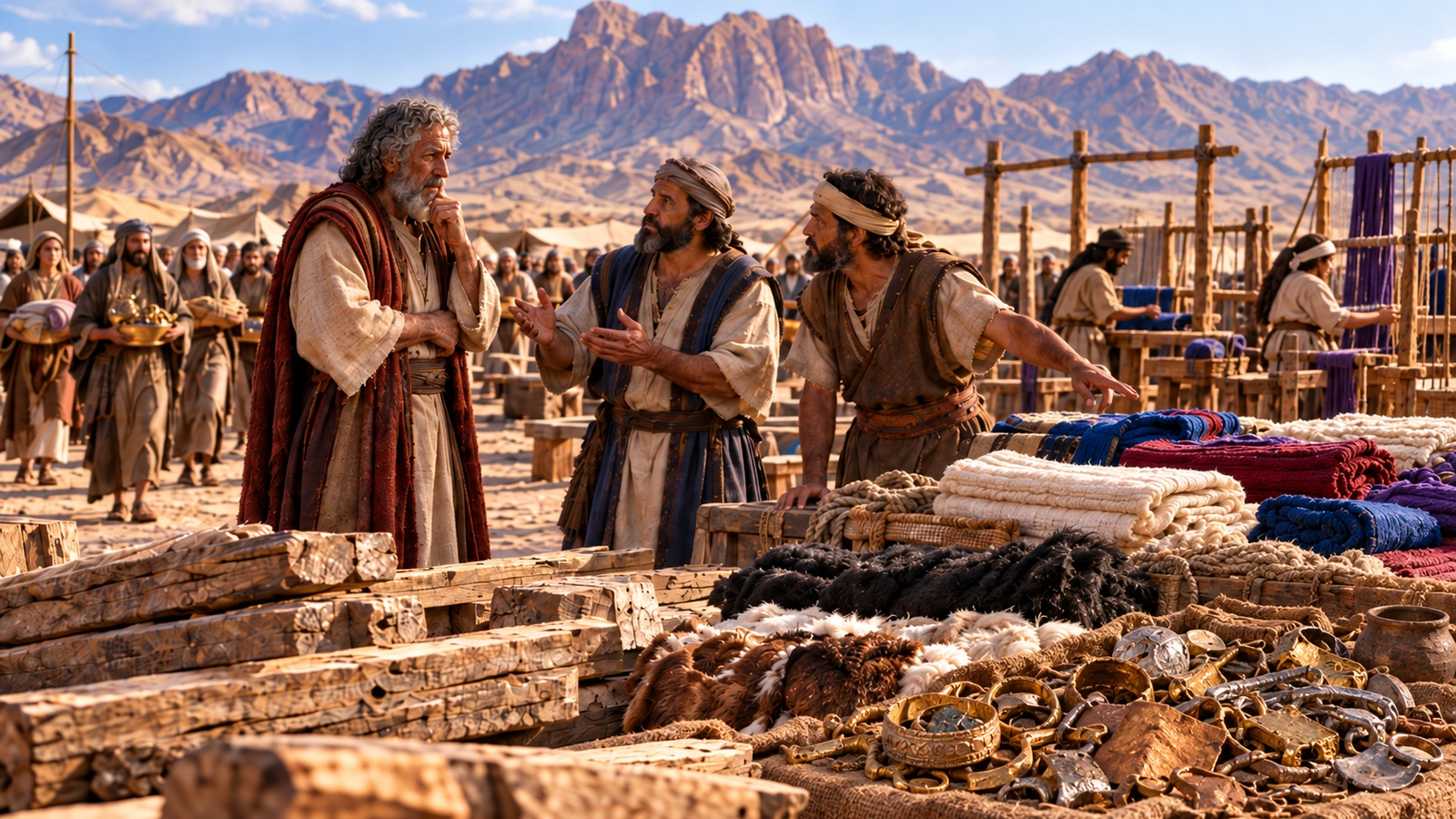
Figure 1. Artistic reconstruction of Jacob remaining with his slow-moving household as Esau departs toward Seir, representing the divergent routes described in Genesis 33:14–17 after their reconciliation. |
Why Does Genesis Leave Jacob Alone Before the Wrestling Begins? ended beside the Jabbok, where the returning patriarch emerged from the night wounded, blessed, and renamed.
Morning brings the confrontation he had feared. Four hundred men approach with Esau, yet the anticipated violence never occurs.
The elder brother runs forward, embraces him, falls upon his neck, and weeps.
After years of estrangement, the immediate threat disappears.
Then Genesis creates a new problem.
Esau proposes that they travel together.
Jacob refuses the offer, citing vulnerable children and livestock that cannot be driven at a warrior’s pace.
His explanation ends with a specific destination:
עַד אֲשֶׁר־אָבֹא אֶל־אֲדֹנִי שֵׂעִירָה — ʿad ʾăšer-ʾāḇōʾ ʾel-ʾăḏōnî Śēʿîrâ
“Until I come to my lord in Seir.”
The next movements are startling.
Esau goes south toward Seir.
Jacob journeys to Succoth.
Afterward he reaches Shechem in Canaan.
No visit to his brother’s territory is subsequently narrated.
Was the promise deceptive?
Did circumstances alter the itinerary?
Could an unrecorded visit have occurred later?
Or has the final form of Genesis preserved a geographical tension without resolving it?
The safest answer begins with an admission:
the text never tells us why.
What it does tell us deserves much closer attention.
Esau Offers More Than Reconciliation
After accepting the enormous gift, the elder twin says:
נִסְעָה וְנֵלֵכָה — nisʿâ wənēlēḵâ
“Let us journey and go.”
He even offers to travel alongside his brother.
This proposal changes the scene from peaceful reunion to possible companionship.
The returning household, however, is poorly suited to the speed of four hundred men.
Young children accompany nursing animals.
Driving such a company too hard, Jacob argues, could destroy the flock in a single day.
Nothing about that explanation is inherently implausible.
Pastoral movement genuinely depends on the weakest members of a traveling group.
Yet what follows creates the interpretive difficulty.
“Until I Come to My Lord in Seir”
The phrase in verse 14 sounds straightforward.
Jacob asks Esau to proceed ahead while he moves:
לְאִטִּי — ləʾiṭṭî
“at my slow pace.”
His progress will correspond to the livestock and children before him.
The final clause names Seir as the point where the brothers will meet again.
One qualification matters.
Genesis does not specify when that arrival is supposed to occur.
The statement can naturally be read as an intention to follow, but it contains no calendar, travel interval, or explicit promise of immediate arrival.
Calling it a deliberate lie from the outset goes beyond what the sentence itself proves.
Esau Makes One More Offer
Verse 15 adds another layer.
The departing brother proposes leaving some of his men behind.
Such an escort could provide protection, guidance, or both.
Jacob declines again:
“Why this? Let me find favor in the eyes of my lord.”
No accusation follows.
No suspicion is voiced by Esau.
The exchange ends peacefully.
That matters because interpretations portraying the scene as an obvious deception must account for the narrator’s refusal to expose one.
Genesis knows how to identify deceit explicitly elsewhere.
Here it does not.
Then the Hebrew Creates a Contrast
Verse 16 reports:
וַיָּשָׁב בַּיּוֹם הַהוּא עֵשָׂו לְדַרְכּוֹ שֵׂעִירָה
Esau returned “that day” on his way toward Seir.
The following line begins differently:
וְיַעֲקֹב נָסַע סֻכֹּתָה — wə-Yaʿăqōḇ nāsaʿ Sukkōṯâ
“Jacob, however, journeyed to Succoth.”
The clause places the subject before the verb, creating a disjunctive construction that contrasts his movement with Esau’s preceding departure. Several English versions capture the force with “But Jacob…”
This is stronger than a vague omission.
Two brothers separate.
Two destinations immediately appear.
One heads toward Seir.
The other does not follow him in the next narrated action.
Succoth Looks More Substantial Than a One-Night Stop
At Succoth, the traveler does something unusual for someone supposedly moving directly toward another destination.
He builds:
בַּיִת — bayiṯ
a “house.”
For his livestock he makes:
סֻכֹּת — sukkōṯ
“booths,” “shelters,” or temporary structures.
The place-name itself is explained from those animal shelters.
A permanent residence cannot automatically be inferred from one bayiṯ.
Neither does Genesis state how long the household stays there.
Still, constructing accommodations moves the episode beyond the picture of a caravan merely stopping for several hours.
Seir has already disappeared from the itinerary being narrated.
The Route Then Turns Toward Canaan
The next location is even more significant.
Genesis 33:18 says the patriarch reaches Shechem:
אֲשֶׁר בְּאֶרֶץ כְּנָעַן — ʾăšer bəʾereṣ Kənaʿan
“which is in the land of Canaan.”
That geographical notice is not necessary merely to identify the city.
It places the arrival explicitly within the territory toward which the return from Paddan-Aram had been directed.
The route from the Jabbok region through Succoth and onward to Shechem moves westward rather than south toward the hill country of Seir. Modern geographical analysis has highlighted precisely this difficulty.
The storyteller now devotes attention to what happens there.
“Shalem” May Mark the Completion of the Return
Verse 18 contains a small Hebrew term with large interpretive consequences:
שָׁלֵם — šālēm
Many modern translations understand it adverbially:
“safely,” “whole,” or “in peace.”
Older traditions sometimes treated Shalem as a place-name.
The grammatical reading “safely” fits the verse well: Jacob reaches Shechem intact after departing Paddan-Aram.
That wording recalls an earlier fear.
At Bethel, the fugitive had spoken about returning in peace to his father’s house.
Later, YHWH promised to guard him and bring him back to the land.
Genesis 33 does not explicitly announce, “the Bethel promise is now fulfilled.”
Yet arrival in Canaan šālēm creates a striking verbal and thematic resonance with the journey that began in Genesis 28.
A Land Purchase Follows
Movement gives way to possession.
For one hundred קְשִׂיטָה — qəśîṭâ, the newcomer purchases a parcel from the sons of Hamor.
The exact nature or later monetary value of the qəśîṭâ is uncertain; translating it as a familiar modern denomination would create false precision.
What matters narratively is the acquisition itself.
A returning migrant who had spent years working on another man’s estate now possesses a legally acquired piece of ground near Shechem.
The episode anchors him in Canaan without claiming that this small tract equals possession of the entire promised territory.
The Chapter Ends at an Altar, Not at Seir
On that purchased ground, Jacob erects an altar.
Its name is:
אֵל אֱלֹהֵי יִשְׂרָאֵל — ʾĒl ʾĔlōhê Yiśrāʾēl
Commonly rendered:
“El, the God of Israel.”
That designation deserves attention because “Israel” is the name received during the previous night’s encounter.
For the first time after Peniel, the new identity appears within an act of worship.
The chapter therefore closes with land, an altar, and the designation Israel—not with an arrival at Esau’s residence.
That literary endpoint does not explain the abandoned itinerary.
It shows where the narrator chooses to place the emphasis.
Does Genesis Say Jacob Broke His Word?
No.
That answer needs to remain firm.
The chapter reports what Jacob said.
It next records a different destination.
It never supplies the sentence:
“Jacob deceived Esau.”
Likewise, no verse says:
“Jacob changed his mind.”
Nor are readers told:
“He visited Seir later.”
Each of those statements adds information the surviving account does not provide.
Historical interpreters have consequently proposed all three possibilities in different forms.
The ambiguity is real.
Could He Have Visited Seir Later?
Nothing makes such a journey impossible.
Genesis is highly selective.
Years can pass between narrated scenes, and many ordinary movements receive no notice.
A later visit could have occurred outside the episodes preserved by the book.
Yet that possibility must remain a possibility.
No subsequent passage records Jacob arriving in Seir to fulfill Genesis 33:14.
The next explicit meeting of the brothers comes much later.
At Isaac’s death, Esau and Jacob bury their father together.
Their renewed contact demonstrates that the Jabbok reconciliation was not necessarily their final interaction.
It still provides no evidence for the missing journey.
The Geography Creates a Genuine Scholarly Problem
Modern source-critical scholarship has approached the discrepancy from another direction.
David Ben-Gad HaCohen argues that the route preserves traces of traditions whose geographical frameworks were later combined. In his reconstruction, an older version connected Jacob’s homecoming more closely with the Seir region, while another strand placed the patriarchal future west of the Jordan.
That proposal is reconstruction, not an explicit statement from Genesis.
Readers should distinguish observable evidence from a theory designed to explain it.
The evidence is straightforward:
the promised destination is Seir;
the immediately narrated stop is Succoth;
the following arrival is Shechem.
How those elements entered their present literary relationship remains debated.
Genesis Later Separates the Brothers Geographically
Chapter 36 eventually gives Esau a territorial identity of his own.
The text repeatedly connects him with:
הַר שֵׂעִיר — har Śēʿîr
the hill country of Seir.
It also identifies him with Edom.
That later genealogy helps readers see the long-range trajectory.
The brothers may reconcile personally, but their lines do not merge into a single household or territory.
Esau becomes associated with Seir.
Jacob’s descendants remain central to the story unfolding in Canaan.
That distinction should not be projected backward as proof of the motive behind verse 17.
Its value is literary rather than psychological.
Reconciliation Does Not Require Shared Geography
This may be the chapter’s most easily overlooked point.
Peace between the brothers does not result in permanent reunion.
Esau can embrace Jacob without the two men becoming traveling companions.
The returnee can accept forgiveness without moving into his sibling’s territory.
Genesis presents reconciliation and separation side by side.
Those outcomes are not contradictory.
Abraham and Lot had already shown that peaceful relations could coexist with geographical division.
The same broad possibility appears here under different circumstances.
The Story Does Not Return to the Old Family Structure
Before Haran, both sons belonged to Isaac’s household.
After the homecoming, that arrangement is never restored.
One brother has built a substantial line associated with Edom.
The other arrives with wives, children, servants, herds, and wealth accumulated during two decades abroad.
Their embrace repairs a violent rupture.
It does not reverse adulthood.
Each now leads an independent house.
This helps explain why the narrative can treat their peaceful separation as a meaningful ending even while the statement about Seir remains unresolved.
What Can Be Said with Confidence?
Four observations stand on firm textual ground.
First, Jacob tells Esau that he will come to him in Seir.
Second, Genesis records no timeframe for that arrival.
Third, the next narrated movement takes him to Succoth rather than southward with his brother.
Fourth, Shechem becomes the subsequent destination, explicitly identified as lying within Canaan.
Beyond those points, certainty decreases.
A deliberate lie is possible but unproven.
A later unrecorded visit cannot be excluded.
Changed plans remain conceivable.
Compositional history offers another explanation, yet depends on reconstructing earlier literary stages.
Good exegesis should not erase the uncertainty merely because readers prefer a single answer.
The Deeper Discovery
The strongest insight may lie in what Genesis does not do.
It never stops to defend Jacob.
No excuse explains the divergent route.
Neither does the narrator prosecute him for dishonesty.
Instead, the geographical sequence simply moves forward.
Esau goes to Seir.
His brother settles temporarily at Succoth.
The returning family eventually reaches Shechem.
Land is purchased.
An altar is erected.
The name Israel enters the closing act of worship.
From a final-form literary perspective, that progression shifts the question.
We begin asking:
Why did Jacob fail to reach the place he mentioned?
The chapter gradually makes us ask something else:
Where is Genesis actually taking him?
The answer supplied by the narrated geography is not Seir.
It is back into Canaan.
That does not prove why Jacob spoke as he did.
It reveals why the unexplained statement does not control the chapter’s ending.
The reconciliation with Esau settles the danger behind him.
The closing verses move the ancestral narrative toward the land in front of him.
Then Genesis 34 violently disrupts that apparent stability.
Shechem is no longer merely a purchased field and an altar site.
Dinah goes out to see the women of the land, Shechem son of Hamor takes her, negotiations begin, and nearly every major male figure is allowed to speak.
The woman at the center of the catastrophe never receives a recorded sentence.
That creates the next question:
Why Does Genesis Let Everyone Speak Except Dinah?
Selected Sources
Alter, Robert. The Art of Biblical Narrative. Basic Books.
Bar-Efrat, Shimon. Narrative Art in the Bible. Sheffield Academic Press.
Hamilton, Victor P. The Book of Genesis: Chapters 18–50. Eerdmans.
HaCohen, David Ben-Gad. “If Jacob Is Returning to Canaan, Why Send Messengers to Esau in Seir?” TheTorah.com, 2019; updated 2026.
Sarna, Nahum M. Genesis. Jewish Publication Society.
Sternberg, Meir. The Poetics of Biblical Narrative. Indiana University Press.
Wenham, Gordon J. Genesis 16–50. Word Biblical Commentary.