Why Does Abraham Buy the Land God Had Already Promised?
Genesis 23 and the First Property Abraham Acquires in Canaan
 |
Figure 1. Artistic reconstruction of Abraham weighing silver before Ephron and local witnesses, representing the public property transfer described in Genesis 23. |
The First Piece of the Promise
Genesis has just introduced the woman who will become Isaac’s wife.
That transition was examined in Why Does Genesis Introduce Rebekah Before Sarah Dies?.
Then Genesis 23 opens with a death.
Sarah dies at Hebron, and Abraham mourns her.
Readers might expect the chapter to focus on burial and grief.
Instead, most of Genesis 23 records a property negotiation.
Abraham speaks with the local sons of Heth.
Ephron enters the discussion.
A field and cave are identified.
Four hundred shekels of silver are weighed.
The property boundaries are specified.
Public witnesses observe the transfer.
Only after all this does Abraham bury Sarah.
The imbalance is striking.
Why does Genesis spend so much time recording a purchase?
God had already promised Abraham the land of Canaan.
Yet when Sarah dies, Abraham still must buy somewhere to bury her.
That apparent contradiction exposes the real tension in Genesis 23.
Abraham possesses the land by promise before he possesses any recorded property within it.
Abraham Has a Promise but Needs a Grave
The land promise began long before Sarah’s death.
Genesis 12:7 promised the land to Abraham’s offspring.
Genesis 13 expanded the vision in every direction.
Genesis 15 defined the promise on a larger geographical scale.
Genesis 17 described Canaan as an everlasting possession for Abraham’s descendants.
Abraham has walked through that country for years.
He has pitched tents there.
He has built altars there.
But Genesis has not yet recorded him purchasing property in Canaan.
Sarah’s death suddenly makes that distinction practical.
Abraham needs a permanent burial place.
He cannot bury a promise.
He needs land he can actually use.
That is why Genesis 23 moves quickly from mourning to negotiation.
Abraham Calls Himself a Stranger and a Resident
Abraham approaches the sons of Heth with an important self-description:
גֵּר־וְתוֹשָׁב אָנֹכִי עִמָּכֶם — gēr-wəṯôšāḇ ʾānōḵî ʿimmāḵem
“I am a stranger and a resident among you.”
The expression combines two ideas.
גֵּר — gēr refers to someone living outside his ancestral social territory.
תּוֹשָׁב — tôšāḇ describes someone residing within another community.
The phrase should not be imported directly into later rabbinic categories.
Within Genesis 23, the point is more immediate.
Abraham lives among these people.
Yet he lacks inherited ownership within their community.
His next request confirms that problem.
He asks for:
אֲחֻזַּת־קֶבֶר — ʾaḥuzzat-qeḇer
A burial holding or burial property.
Abraham does not ask merely for permission to use a grave.
He seeks a place connected with recognized possession.
That creates the chapter’s central irony.
The man promised Canaan describes himself as a resident outsider within it.
Why Does Abraham Refuse the Offered Land?
The sons of Heth initially respond with generosity.
They call Abraham a “prince of God” among them.
They allow him access to their finest tombs.
Then Ephron offers something greater.
He presents both the field and its cave to Abraham.
The language sounds like a gift.
Abraham refuses.
He bows before the people and insists on paying.
This moment has generated many explanations.
Some interpreters describe the exchange as conventional bargaining.
Others seek specific ancient legal reasons behind Abraham’s decision.
Those possibilities deserve caution.
Genesis never says Abraham rejects the offer because free land could later be reclaimed.
It never explains an undocumented Hittite property law.
Such reconstructions should not become biblical facts.
The narrative gives us something firmer.
Abraham wants to pay.
Ephron states a value.
Abraham accepts it.
The transfer then becomes public and unmistakable.
That is enough to explain why the payment matters narratively.
No future reader needs to wonder whether Abraham merely borrowed Sarah’s grave.
Four Hundred Shekels Were Weighed, Not Minted
Ephron names the amount:
four hundred shekels of silver.
Genesis does not describe coins.
Coinage belongs to a much later monetary world.
A shekel here functions as a unit of weight.
Verse 16 explicitly says Abraham weighed the silver.
The Hebrew verb is:
וַיִּשְׁקֹל — wayyišqōl
“He weighed.”
This tiny detail places the transaction within a recognizable ancient economic practice.
Silver circulated by weight across the ancient Near East long before coined currency.
Genesis then adds an unusually difficult phrase:
כֶּסֶף עֹבֵר לַסֹּחֵר — keseph ʿōḇēr lassōḥēr
Many English translations understand this as commercially acceptable silver.
The precise expression, however, remains debated.
A 2024 study by Josef Tropper, Juan-Pablo Vita, and Manuel Molina challenges the traditional rendering.
Their analysis compares Genesis 23:16 with ancient Near Eastern legal documents.
Those records show merchants or trained specialists weighing large silver payments.
The authors propose that a merchant may actually participate in the scene as a silver-weigher.
That interpretation is not certain.
Its importance lies elsewhere.
Genesis preserves transaction details that fit a wider world of weighed-silver commerce.
The historical parallel illuminates the scene without proving its date.
The Text Carefully Defines What Changed Hands
After Abraham weighs the silver, Genesis becomes unusually precise.
Ephron’s property at Machpelah is identified.
The field is included.
The cave within it is included.
The trees inside its boundaries are included.
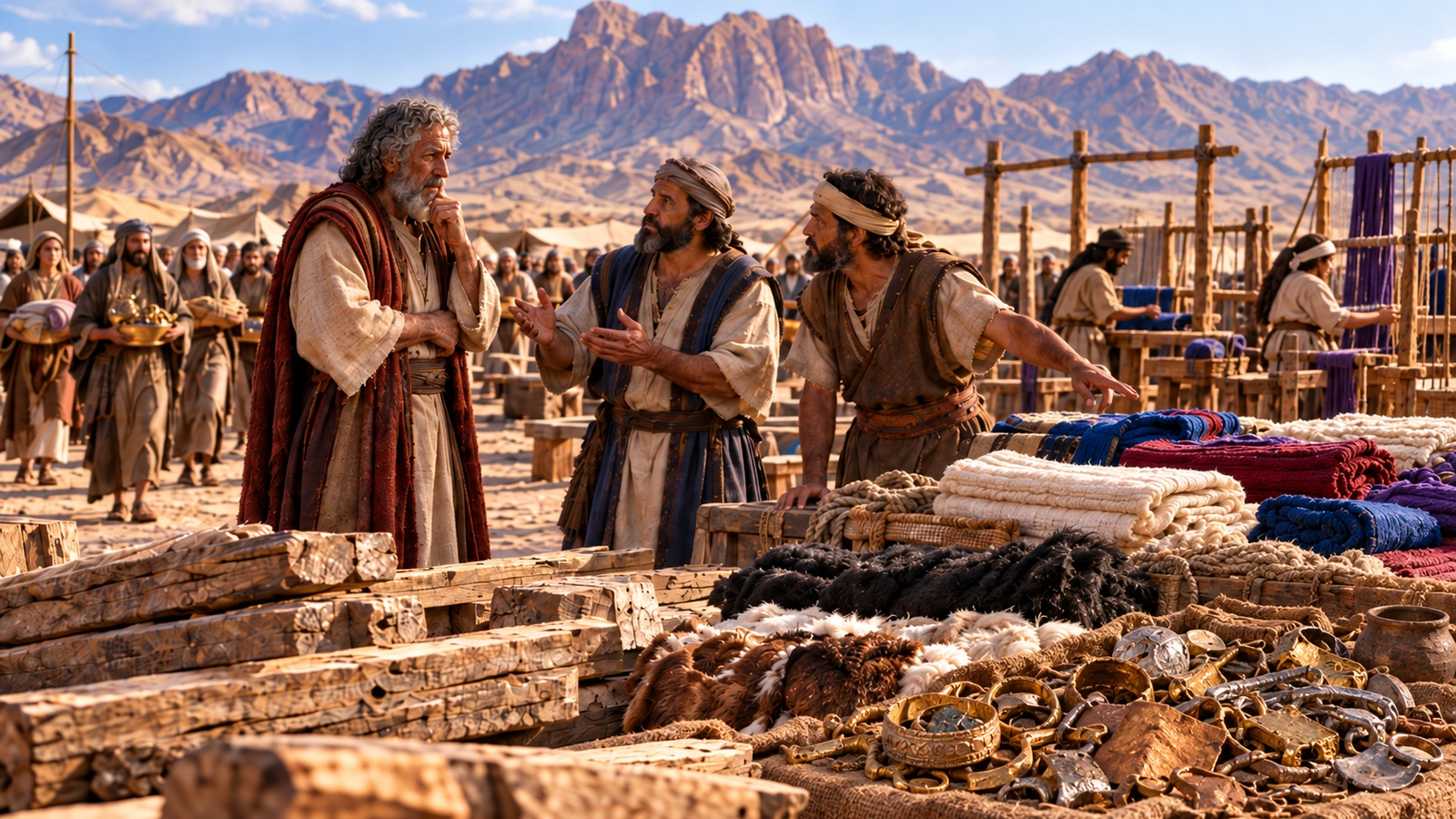
The people entering the city gate witness what occurs.
Then Genesis uses a striking verb:
וַיָּקָם — wayyāqom
The verb comes from קוּם — qûm, commonly associated with rising or standing.
Here, translations often render the field as “made over,” “confirmed,” or “established.”
The property now stands recognized as Abraham’s possession.
Genesis repeats that confirmation after Sarah’s burial.
The repetition is functional.
Verse 17 establishes the transfer before the burial.
Verse 20 closes the episode by identifying its lasting purpose.
The field and cave have become Abraham’s burial property.
The narrator wants no ambiguity about ownership.
The City Gate Makes the Transaction Public
The setting adds another layer.
Ephron speaks before people entering the city gate.
Genesis does not describe a private exchange inside Abraham’s tent.
The transfer occurs before the local community.
City gates later appear elsewhere in biblical literature as places for public decisions.
Ruth 4 provides a famous example involving land, witnesses, and legal recognition.
Jeremiah 32 likewise records a land purchase with careful attention to payment and witnesses.
Those later texts should not simply be projected backward onto Genesis 23.
Still, they show why public visibility matters within biblical legal culture.
Genesis 23 repeatedly stresses who heard and witnessed the exchange.
Scholars have long studied these legal features.
Gene Tucker examined Genesis 23 against ancient Near Eastern contract traditions.
Raymond Westbrook later analyzed the Machpelah transaction from comparative legal perspectives.
Their work also illustrates an important caution.
The passage cannot be securely mapped onto one simple “Hittite law” template.
Ancient legal comparison is useful.
Direct historical identification requires more evidence.
Is This Really Abraham’s First Piece of the Promised Land?
Here we need precise language.
Genesis 23 never says:
“This is the first fulfillment of the land promise.”
That sentence would be interpretation.
What the narrative explicitly records is narrower.
Abraham receives promises concerning Canaan.
He later purchases the field and cave at Machpelah.
Genesis then identifies that property as his burial holding.
Within the narrative, this is the first property acquisition by Abraham in Canaan described in detail.
That makes a theological connection reasonable.
The land once known only through promise now includes a place Abraham possesses.
But the scale remains deliberately small.
Abraham does not receive a kingdom.
He does not control Hebron.
He does not inherit Canaan politically.
He acquires a grave.
That contrast gives the chapter much of its power.
A Burial Plot Is Not the Fulfillment of the Whole Promise
Calling Machpelah a fulfillment requires qualification.
God’s land promise is much larger.
Genesis speaks about descendants inhabiting Canaan.
Later biblical narratives connect that promise with Israel’s national history.
A burial field cannot exhaust those claims.
Machpelah is better understood as a concrete anticipation within the patriarchal narrative.
The promise remains future.
Yet Abraham is no longer connected with Canaan only through movement and altars.
His family now has a permanent burial site there.
That distinction becomes even more important later.
Abraham himself will be buried at Machpelah.
Isaac and Ishmael will place him there.
Genesis later associates Isaac, Rebekah, Jacob, and Leah with the same ancestral burial place.
The grave purchased for Sarah becomes a family anchor.
Death creates permanence where life had been marked by tents.
Why a Grave?
This is perhaps the most unexpected feature of Genesis 23.
Abraham’s first recorded acquisition in Canaan is not farmland for expansion.
It is not a palace.
It is not a military stronghold.
It is not a city.
It is a tomb.
That choice changes the emotional force of the land theme.
Machpelah looks backward because Sarah is buried there.
But it also points forward.
Choosing burial in Canaan binds Abraham’s family to that land beyond one lifetime.
The patriarch can still move.
His descendants can still travel.
Famine can send the family elsewhere.
A grave remains.
Genesis later uses burial location as a powerful statement of family attachment.
Jacob will eventually insist that Egypt must not become his final resting place.
His instructions return the reader to this same property.
Machpelah outlives the people who purchased it.
What Does Genesis 23 Actually Allow Us to Say?
The explicit evidence is strong.
God had promised Canaan to Abraham and his descendants.
Sarah dies while Abraham still describes himself as a resident outsider.
Abraham purchases Machpelah from Ephron.
Silver is weighed before local witnesses.
The field, cave, trees, and boundaries receive careful attention.
The property becomes a burial holding.
Those points come directly from the narrative.
The next step is interpretation.
Machpelah can reasonably be read as a tangible anticipation of the land promise.
Several major commentators understand the acquisition within that covenantal trajectory.
Yet Genesis does not label the transaction “partial fulfillment.”
Nor does it explain Abraham’s motives in those exact theological terms.
The distinction protects the argument.
We do not need to make the text say more than it says.
Its narrative sequence already carries remarkable force.
The Deeper Discovery
The initial question asks why Abraham buys land God already promised.
But Genesis 23 exposes a sharper paradox.
Promise and possession are not the same thing.
Abraham has received the promise.
He still lives as a gēr wəṯôšāḇ.
Sarah’s death forces those two realities into the same scene.
The result is not immediate national fulfillment.
It is a field, a cave, and a grave.
That small acquisition matters because it changes Abraham’s relationship with Canaan.
The promised future now has a permanent family location within the land.
Yet Genesis refuses to accelerate the story.
Sarah is buried.
Genesis 24 turns toward Isaac and Rebekah.
Then Genesis 25 begins closing other branches of Abraham’s family.
Abraham dies.
Ishmael’s descendants are listed.
Only after those lines are completed does Genesis announce:
“These are the generations of Isaac.”
The pattern creates the next mystery.
Genesis repeatedly seems to finish one family line before following another.
Why?
Why Does Genesis Always Finish One Family Before Following Another?
Selected Sources
Hamilton, Victor P. The Book of Genesis: Chapters 18–50. New International Commentary on the Old Testament. Eerdmans, 1995.
Mathews, Kenneth A. Genesis 11:27–50:26. New American Commentary. Broadman & Holman, 2005.
Sarna, Nahum M. Genesis. JPS Torah Commentary. Jewish Publication Society, 1989.
Tropper, Josef, Juan-Pablo Vita, and Manuel Molina. “Abraham, Ephron and the Merchant. kæsæp ʿober lassoḥer (Genesis 23:16) in the Light of Ancient Near Eastern Silver Weighers.” Zeitschrift für die Alttestamentliche Wissenschaft 136.2 (2024): 219–229. DOI: 10.1515/zaw-2024-2007.
Tucker, Gene M. “The Legal Background of Genesis 23.” Journal of Biblical Literature 85.1 (1966): 77–84. DOI: 10.2307/3264358.
Wenham, Gordon J. Genesis 16–50. Word Biblical Commentary 2. Word Books, 1994.
Westbrook, Raymond. “Purchase of the Cave of Machpelah.” Israel Law Review 6.1 (1971): 29–38.