Why Does Abram Never Pass Between the Covenant Pieces?
What Genesis 15 Says About the Covenant Abram Never Walked Through
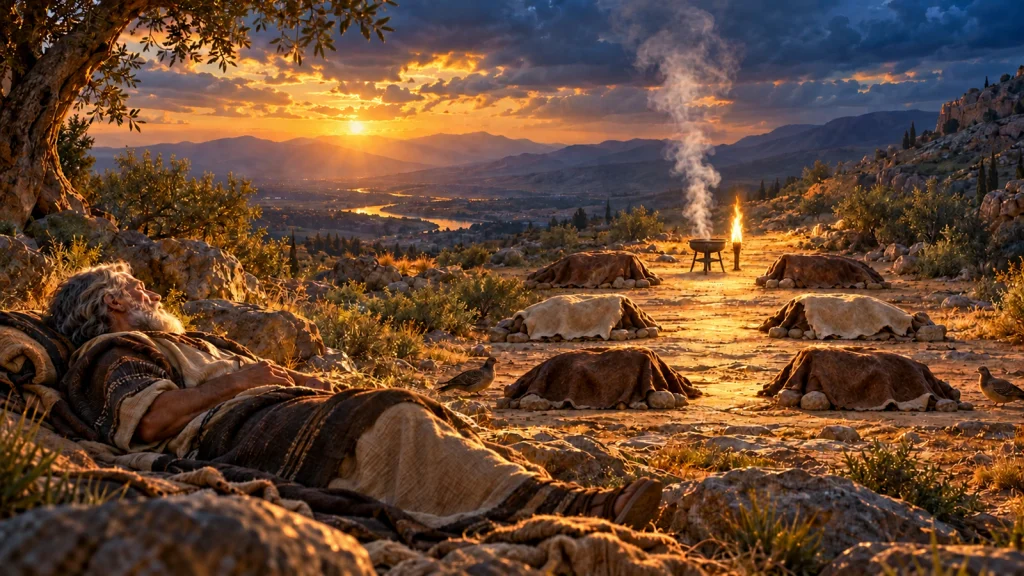
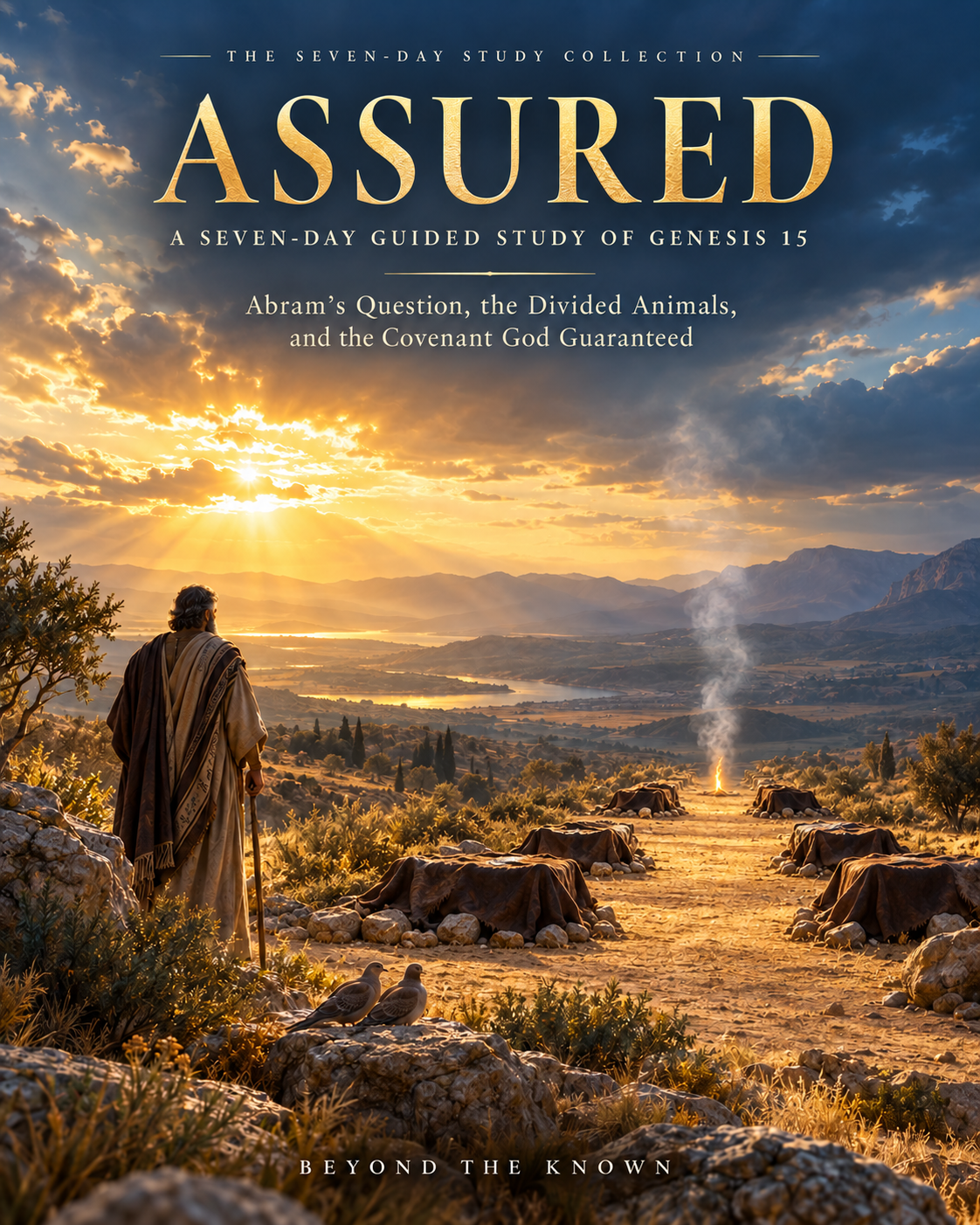
Figure 1. Artistic representation of the smoking firepot and flaming torch passing between the divided animals while Abram lies in a deep sleep, based on Genesis 15:12–18. Genesis does not describe the precise appearance of these elements. |
After the separation explored in Why Did God Tell Abraham to Look After Lot Left?, Abram was promised land in every direction but still possessed no permanent inheritance. Genesis 14 then placed him among kings and armies; Genesis 15 returns to the unresolved problem beneath those events: How can God’s promises of land and descendants be fulfilled while Abram remains childless?
God answers with one of the Bible’s most enigmatic covenant scenes. Abram brings animals, divides the larger ones, and arranges their halves opposite each other. Darkness falls. A smoking firepot and a flaming torch pass between the pieces, and the LORD makes a covenant with him.
Abram is never described as passing between them.
Why not?
The shortest answer is that Genesis 15 presents the covenant as God’s guarantee of the promise. Abram prepares the animals and receives the revelation, but the only things shown moving between the pieces are the fiery and smoky signs widely understood to represent the divine presence.
That conclusion still requires care. Genesis does not say that God assumed a visible human body and walked through the animals. Nor does it record a command that Abram was supposed to cross between them. The meaning emerges from the ceremony’s sequence, its biblical parallels, and the statement immediately afterward that the LORD “made”—literally, “cut”—a covenant with Abram.
The title uses “Abraham” for search familiarity. Throughout Genesis 15, however, the narrative still calls him Abram. His name will change in Genesis 17.
Why Does Abram Ask for Assurance?
The Promise Has Not Yet Produced an Heir
Genesis 15 begins with divine reassurance:
“Do not be afraid, Abram. I am your shield, your very great reward.”
Genesis 15:1, NIV
The command not to fear follows Abram’s military victory and his refusal to accept wealth from the king of Sodom. The text does not identify one specific danger behind his fear. Instead, Abram’s reply reveals what troubles him most: he remains childless.
God has promised to make him a great nation, but no son has appeared. Abram says that a member of his household will inherit his estate, and he names Eliezer of Damascus. God responds that this man will not be his heir; a son from Abram’s own body will inherit.
Then God takes him outside and directs his attention upward:
“Look up at the sky and count the stars—if indeed you can count them. … So shall your offspring be.”
Genesis 15:5, NIV
The narrator follows with the famous statement that Abram believed the LORD, who credited it to him as righteousness. Within Genesis 15, this declaration comes before the divided animals. Abram’s faith is therefore not created by the ceremony; the ceremony addresses the question that follows.
Later biblical writers, especially Paul in Romans 4 and Galatians 3, develop Genesis 15:6 when discussing faith and righteousness. Those are important later canonical interpretations. In the original narrative, the verse first characterizes Abram’s response to God’s promise of descendants.
A Second Question Concerns the Land
God then identifies himself as the one who brought Abram from Ur to give him the land. Abram asks:
“Sovereign LORD, how can I know that I will gain possession of it?”
Genesis 15:8, NIV
The question is sometimes treated as unbelief, but Genesis does not rebuke Abram for asking it. It also need not contradict the statement that he believed. The first exchange concerned an heir; the second asks how he will know that the promised land will become his inheritance.
God does not answer with an abstract explanation. He instructs Abram to bring a three-year-old heifer, a three-year-old goat, a three-year-old ram, a turtledove, and a young pigeon.
Abram divides the three larger animals and places their halves opposite each other. He does not divide the birds. The text gives no symbolic explanation for each species, their ages, or the undivided birds, so interpretations assigning a separate theological meaning to every animal move beyond what Genesis states.
Birds of prey descend on the carcasses, and Abram drives them away. Some later interpreters have connected the predators with the nation that will oppress Abram’s descendants. That reading may fit the revelation that follows, but the narrative never identifies the birds symbolically. Their immediate function is clear enough: Abram protects the prepared animals while he waits.
What Kind of Ceremony Is This?
“Cutting” a Covenant
The Hebrew Bible commonly uses the expression כָּרַת בְּרִית — kārat bərît for making a covenant. The verb kārat can mean “cut,” so the phrase may be rendered more formally as “cut a covenant.” In Genesis 15, the wording acquires unusual visual force because animals have literally been cut before the covenant is announced.
The clearest biblical parallel appears in Jeremiah 34. There, people cut a calf in two and pass between its parts when making a covenant. After they violate that covenant, God declares that they will become like the calf they divided.
Jeremiah makes explicit what many scholars infer about such ceremonies: passing between slaughtered animals could enact a solemn self-curse. The participants effectively accepted the fate represented by the carcasses if they broke their commitment.
Ancient Near Eastern treaty and grant traditions provide broader evidence that killed animals and enacted curses could accompany binding agreements. Moshe Weinfeld famously compared Genesis 15 with royal grants in which a superior guaranteed benefits to a recipient. Dennis McCarthy’s study of ancient treaties likewise shows that covenant rituals varied and should not be reduced to a single universal formula.
That caution is important. Genesis 15 does not preserve a spoken sentence such as, “May I become like these animals if I fail.” Jeremiah helps explain the imagery, but its wording should not simply be inserted into Genesis as though the earlier chapter quoted it.
Does Genesis Expect Both Parties to Pass?
Popular explanations often claim that both covenant partners would normally walk between the pieces and that Abram’s absence therefore breaks the expected pattern.
The difficulty is that Genesis never states this rule. God tells Abram which animals to bring, and Abram understands that the larger ones should be divided, but no verse commands him to walk between them. The story also does not say that he began the crossing or failed to complete it.
Jeremiah 34 shows multiple human participants passing between a divided calf, but that does not prove that every covenant ceremony required every party to perform the same act. Ancient agreements could place different obligations on rulers, subjects, donors, and recipients.
We can therefore make a more precise observation: whatever an audience may have expected, Genesis depicts only the smoking firepot and flaming torch passing between the pieces. Abram is present as the recipient of the vision, but he is not described as joining their movement.
What Passes Between the Pieces?
Smoke, Fire, and Darkness
As the sun sets, “a deep sleep” falls upon Abram, followed by terrifying darkness. The Hebrew noun for this sleep, תַּרְדֵּמָה — tardēmâ, also describes Adam’s sleep in Genesis 2:21. In both narratives, the human figure becomes inactive while God carries the decisive action forward.
Genesis does not say that Abram ceases to perceive everything. He receives a revelation concerning his descendants: they will live as strangers, endure oppression for four hundred years, leave with possessions, and return in the fourth generation. The land promise is confirmed, but its fulfillment will pass through displacement and suffering.
The delay is also connected with the people already living in the land. God says that “the sin of the Amorites has not yet reached its full measure” (Genesis 15:16). The promise does not authorize Abram to seize the land immediately. Its fulfillment belongs to a future generation and is placed within a narrative of both deliverance and judgment.
After sunset, the scene reaches its visual climax:
“A smoking firepot with a blazing torch appeared and passed between the pieces.”
Genesis 15:17, NIV
The firepot was probably a portable oven or brazier rather than a large industrial furnace. Together, smoke and flame create a mysterious manifestation rather than an anthropomorphic portrait of God.
The verse itself calls these objects a smoking firepot and a flaming torch; it does not add the explanatory phrase “these were God.” Yet the next sentence says that on that day the LORD made a covenant with Abram. Fire, smoke, and thick darkness also become signs of divine presence elsewhere in the biblical canon, particularly in the Exodus and Sinai narratives.
For these reasons, commentators across different traditions commonly understand the paired images as representing the LORD’s presence. This is a strong textual and canonical inference, not a claim that Genesis describes God as a human figure walking through the scene.
Why Is Abram Not Shown Passing?
Abram is not completely passive throughout the chapter. He questions, believes, brings the animals, divides them, arranges them, and protects them from predators. Calling him inactive without qualification would ignore much of the story.
At the covenant’s decisive moment, however, the contrast is unmistakable. Abram does not negotiate the boundaries, pledge matching territory, or pass between the pieces. The movement belongs to the signs of divine presence, and the promise that follows is spoken by God.
The ceremony therefore emphasizes divine commitment. If the divided animals evoke a self-curse, the passage symbolically places the covenant’s guarantee on the divine side. In the language of the narrative, the LORD binds the promise of land to himself.
This does not require us to imagine that God could literally be killed like an animal. Ritual actions communicate through symbolic enactment. Nor should we turn the reconstructed self-curse into a direct quotation from God. Genesis makes the theological point through the image, not through an explanation of its mechanics.
Is the Covenant Completely Unconditional?
The scene is often described as a unilateral or unconditional covenant. That language captures something important: Genesis 15:18 presents God as the one who establishes the covenant and grants the land, while Abram is not shown taking a corresponding oath between the pieces.
Weinfeld’s category of a “covenant of grant” helps explain this promissory structure. Unlike a treaty centered primarily on duties imposed upon a subordinate, a grant emphasizes benefits guaranteed by the superior party.
But “unconditional” can become misleading if it is made to describe every aspect of Abram’s relationship with God. Genesis 17 will tell Abram to walk before God and be blameless, establish circumcision as the covenant sign, and describe consequences for refusing that sign. Genesis 22 will place his obedience at the center of another severe test.
Genesis 15 does not erase those later demands. Its particular emphasis is narrower and more precise: the future grant of land and descendants rests on God’s declared commitment before Abram can bring that future into existence.
That distinction also protects the role of faith. Abram’s inability to secure the promise does not mean his response is irrelevant. Genesis explicitly records his belief before the covenant ceremony begins. The chapter holds divine initiative and human trust together without making them identical.
The Deeper Discovery
The initial question asks why Abram did not pass between the divided animals.
Genesis never says that he refused, failed, or was even commanded to do so. What the narrative deliberately shows is that the smoking firepot and flaming torch pass through while Abram receives the covenant rather than ratifying it as an equal partner.
The deeper discovery is not simply that “God did everything and Abram did nothing.” Abram has already believed, questioned, prepared, and waited. The sharper point is that none of those actions can manufacture the heir, accelerate the promised timetable, or create the inheritance.
The covenant ceremony answers Abram’s request for assurance by relocating certainty. The promise will survive childlessness, foreign residence, oppression, and centuries of delay because its guarantee does not rest on Abram’s power to produce the outcome.
Genesis 15 ends with the LORD cutting the covenant while the patriarch is still named Abram. The next chapter shows a human attempt to secure descendants through Hagar, resulting in the birth of Ishmael. Then, in Genesis 17, God returns to the covenant, introduces circumcision, and gives both Abram and Sarai new names.
If the promise was already guaranteed, why did Abram’s identity also need to change?
That is the next question in the story:
Why Did God Change Abram’s Name to Abraham?
Selected Sources
- Arnold, Bill T. Genesis. New Cambridge Bible Commentary. Cambridge University Press, 2008. DOI: 10.1017/CBO9780511807404.
- Hamilton, Victor P. The Book of Genesis: Chapters 1–17. New International Commentary on the Old Testament. Eerdmans, 1990.
- Mathews, Kenneth A. Genesis 11:27–50:26. New American Commentary 1B. Broadman & Holman, 2005.
- McCarthy, Dennis J. Treaty and Covenant: A Study in Form in the Ancient Oriental Documents and in the Old Testament. 2nd ed. Analecta Biblica 21A. Biblical Institute Press, 1978.
- Sarna, Nahum M. Genesis. JPS Torah Commentary. Jewish Publication Society, 1989.
- Weinfeld, Moshe. “The Covenant of Grant in the Old Testament and in the Ancient Near East.” Journal of the American Oriental Society 90.2 (1970), pp. 184–203. DOI: 10.2307/598135.
- Wenham, Gordon J. Genesis 1–15. Word Biblical Commentary 1. Word Books, 1987.