Who Were the Nephilim?
Genesis 6, the Nephilim, the “Sons of God,” and the Mystery Behind an Ancient Name
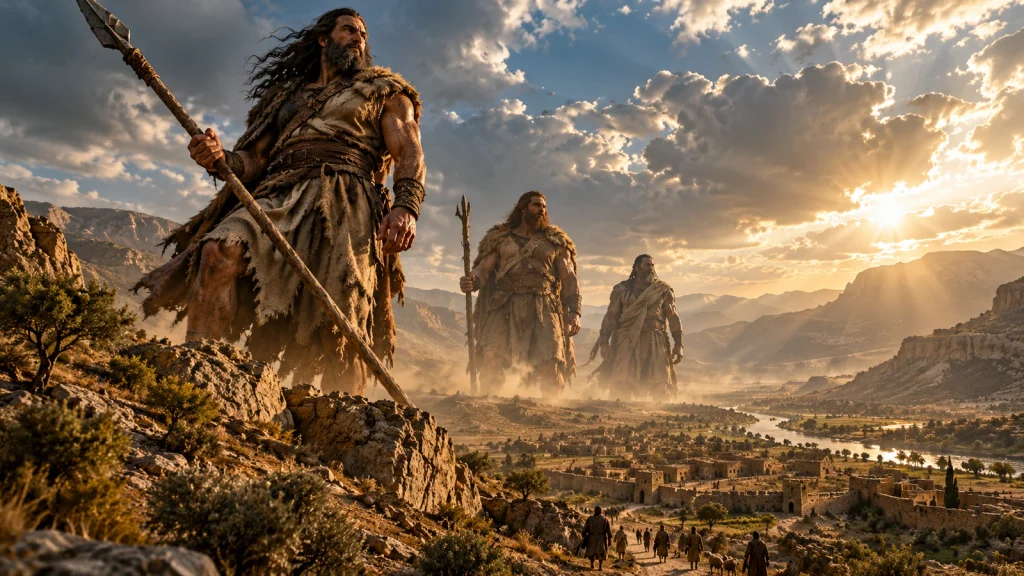
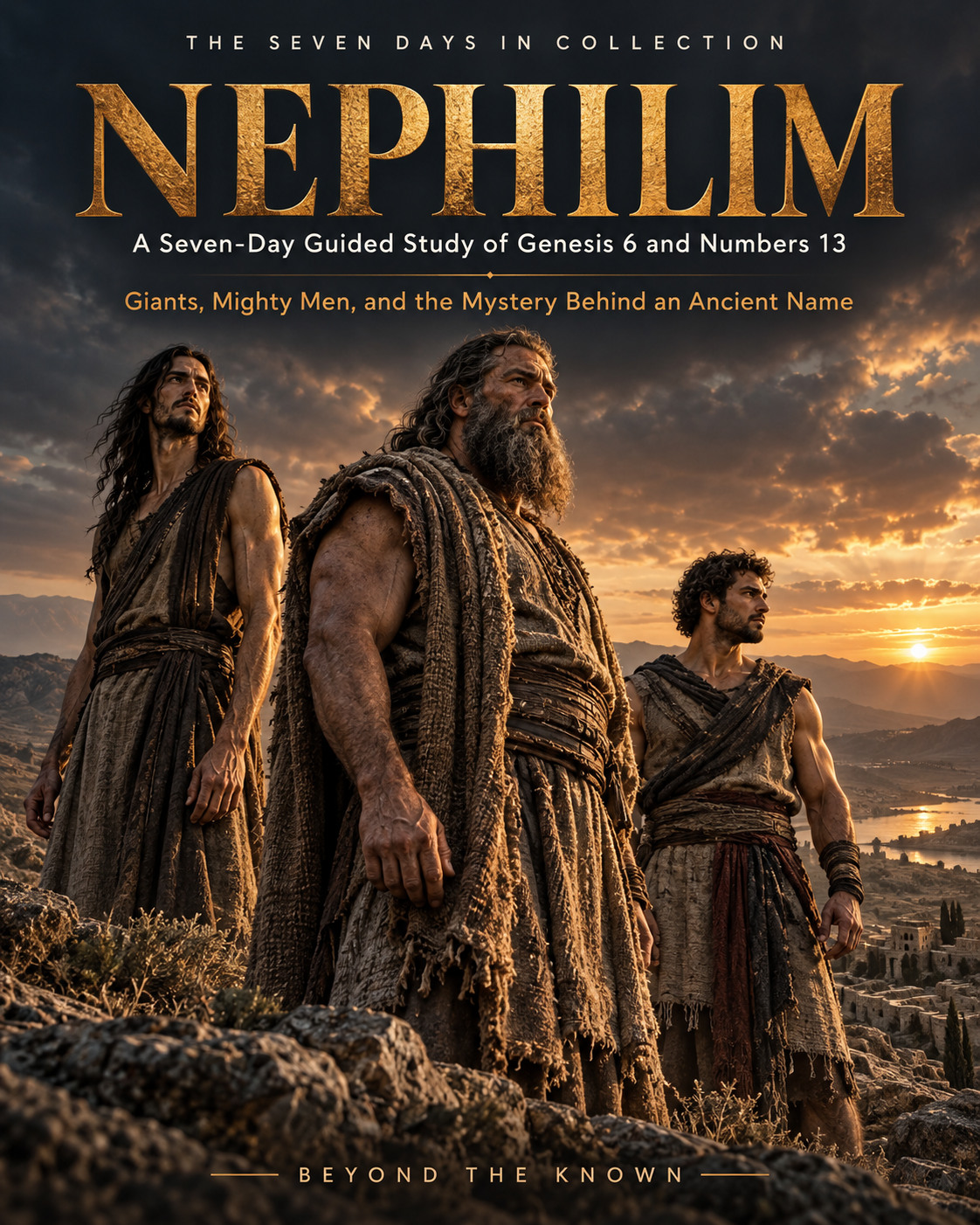
Source: AI-generated illustration created for Beyond The Known.
Genesis has just introduced the mysterious “sons of God,” whose possible identity was examined in Who Were the Sons of God in Genesis 6? Angels, Sethites, or Kings? Yet identifying those figures does not automatically identify another group named in the same passage.
Genesis calls them the Nephilim.
The most careful answer is that the Nephilim were extraordinary figures associated with the ancient world of Genesis 6. The passage connects them with the time when the sons of God took human women and describes figures from that period as mighty men of renown. Numbers 13 later associates the name with the formidable Anakites and with extraordinary size.
That evidence explains why the Nephilim became known as giants. It does not prove that “giants” is the literal meaning of their name, that the Nephilim were themselves fallen angels, or even that Genesis unambiguously identifies them as the children born from the mysterious unions.
The tradition is more definite than the text.
What Does Genesis Actually Say About the Nephilim?
The Name Appears Without an Explanation
Genesis 6:4 begins:
“The Nephilim were on the earth in those days—and also afterward.”
Genesis 6:4, NIV
The rest of the verse mentions the sons of God entering into relationships with human women, children being born, and the gibbōrîm of ancient times—the “mighty men” or “heroes” who became people of renown.
This is the first biblical appearance of the Nephilim, but the narrator pauses neither to define their name nor to describe their bodies. The term occurs in only one other biblical passage, Numbers 13:33. Everything readers conclude must therefore be built from two difficult texts, an ancient Greek translation, and later interpretive traditions.
Genesis makes several points explicit:
- the Nephilim were present “in those days”;
- the sons of God took women and children were born;
- ancient gibbōrîm became famous;
- the Nephilim were also known “afterward.”
What remains less certain is how those statements fit together.
Were the Nephilim the Children of the Sons of God?
The familiar interpretation reads the sequence as a line of descent: the sons of God joined themselves to human women, and their children were the Nephilim—extraordinary beings who became the mighty heroes of old.
This is a natural reading, especially if the “sons of God” are understood as heavenly beings. It also became the foundation of a highly influential interpretation in ancient Jewish literature.
Genesis 6:4, however, does not express the relationship as directly as a modern genealogy would. It first says that the Nephilim were on the earth during that period. It then describes the unions and births before concluding, “They were the mighty men who were of old, the men of renown.” The pronoun may point to the children, while the Nephilim may be identified with those children and mighty men.
But another reading remains grammatically possible: the Nephilim were already present when the unions occurred, while the children born from those unions became the famous gibbōrîm. The verse places all of these figures within the same remote age without defining every relationship between them.
The offspring interpretation is plausible and historically important. It should not be presented as though Genesis simply said, “Their children were called the Nephilim.”
What Does Nephilim Mean in Hebrew?
The Hebrew name is:
נְפִלִים — nəp̄îlîm
It is often connected with the Hebrew root n-p-l, “to fall.” That proposed connection has produced translations such as “fallen ones,” “those who fell,” and “those who cause others to fall.” None of these explanations is secure enough to function as a settled definition.
The form of the noun is unusual, and Genesis offers no wordplay explaining it. Even if the name is historically related to “falling,” the direction of the image remains uncertain. Did they fall from heaven, fall in battle, cause others to fall, or inspire terror? Different interpreters have proposed each possibility.
This is why many modern English translations preserve Nephilim as a name rather than translating it. “Fallen ones” is an etymological proposal. It is not what Genesis explicitly tells readers the word means.
Were the Nephilim Fallen Angels?
Genesis never calls the Nephilim angels—fallen or otherwise.
The confusion usually begins by merging every mysterious figure in the passage. If the sons of God were heavenly beings and if they violated a divine boundary, they may be described theologically as rebellious or fallen beings. The Nephilim, however, are named separately.
In the later interpretation preserved in 1 Enoch, the distinction becomes even clearer. The Watchers are the rebellious heavenly beings; the gigantic offspring born from their unions with women are a different group. Calling the Nephilim “fallen angels” therefore collapses the fathers and the offspring even within the tradition most often used to support the angelic interpretation.
The Nephilim may have been understood as the children of rebellious heavenly beings. That is not the same claim as saying that they were those heavenly beings.
CONTINUE BEYOND THE ARTICLE
Who Were the Nephilim? Go Deeper.
Explore Genesis 6 and Numbers 13 through a careful seven-day guided study.
✓ 50 pages ✓ Two PDF editions
Why Did the Nephilim Become Known as Giants?
The Septuagint Shaped the Tradition
Centuries before the New Testament period, Jewish translators rendered the Hebrew Scriptures into Greek. In Genesis 6:4 they translated Nephilim with:
γίγαντες — gigantes
This is the source behind the familiar English word “giants.” The translation is ancient and significant, but its Greek associations were broader than a simple measurement of height. In Greek literature, gigantes could evoke primordial, earthborn, violent, or god-defying figures from the heroic past.
The Septuagint therefore shows that ancient translators understood the Nephilim as extraordinary beings comparable to the giants of remembered antiquity. It does not prove that the Hebrew noun itself literally means “very tall people.”
Numbers 13 Provides the Strongest Biblical Connection with Size
The association with physical size does not depend on the Septuagint alone. When the Israelite spies describe the inhabitants of Canaan, they report:
“We saw the Nephilim there … We seemed like grasshoppers in our own eyes.”
Numbers 13:33, NIV
The preceding verse describes the inhabitants as people of great size, and verse 33 associates the Nephilim with the Anakites. Within this report, the Nephilim are clearly part of an image of overwhelming stature and strength.
Yet the narrative setting matters. Numbers 13:32 calls the spies’ account a damaging or bad report, and their words are designed to persuade Israel that entering the land is impossible. The grasshopper comparison is rhetorical, not an objective measurement. The report may contain real observations expressed through fear and exaggeration; the text does not require readers to treat every detail as neutral description.
Numbers nevertheless establishes something Genesis 6 alone does not: in later biblical memory, the name Nephilim could evoke terrifying people of exceptional size. Calling them giants is therefore not a baseless tradition. It is a contextual interpretation built especially from Numbers, not a complete lexical translation supplied by Genesis.
What Does “And Also Afterward” Mean?
Genesis says the Nephilim were on the earth “in those days—and also afterward.” The phrase is one of the passage’s most difficult details because the Flood narrative soon describes the destruction of life outside the ark.
Some readers understand “afterward” as the period later remembered in Numbers, implying a post-Flood appearance of the Nephilim. Others take it more narrowly as the time following the unions but still before the Flood. Still others see the phrase as a narrative link between ancient traditions about the pre-Flood world and Israel’s later traditions about giant peoples in Canaan.
Genesis does not explain survival, renewed descent, or a second origin. Claims that a Nephilim ancestor secretly survived aboard the ark, or that the same supernatural event happened again after the Flood, attempt to solve a problem the text itself leaves unresolved.
The words “and also afterward” preserve the connection. They do not tell us how it worked.
How Did the Book of Enoch Expand the Story?
The ancient Jewish work known as 1 Enoch does what Genesis does not: it develops the brief episode into a detailed account of rebellion, forbidden knowledge, gigantic offspring, violence, and judgment.
In the Book of the Watchers, heavenly beings descend, take human women, and produce giants whose destructive appetites devastate the earth. The Watchers teach forbidden practices, the giants turn to violence, and judgment is announced against both groups. The spirits associated with the dead giants then become part of the work’s explanation for the continuing presence of evil spirits in the world.
These details are absent from Genesis 6:1–4. Genesis does not name Watchers, describe their descent, record an oath, list forbidden teachings, give the giants measurements, or explain the origin of demons.
This does not make 1 Enoch irrelevant. It is crucial evidence for how some Jews in the Second Temple period interpreted Genesis and connected the mysterious unions with the spread of violence before the Flood. The discovery of related giant traditions among the Dead Sea Scrolls demonstrates how extensively the four biblical verses continued to generate new stories.
But 1 Enoch must be identified as an ancient interpretation and expansion, not quoted as though it were the missing continuation of Genesis 6:4.
Its relationship with Genesis leaves a larger question open for a future investigation:
Does the Book of Enoch preserve an older background that Genesis assumes, or does it build a new explanation from what Genesis leaves unsaid?
The Deeper Discovery
The most important silence in Genesis 6 is not the height of the Nephilim.
Genesis never explicitly says that they were the reason God sent the Flood. Verse 4 remembers the Nephilim and the famous mighty men of ancient times. Verse 5 then turns directly to the greatness of human wickedness and the continual inclination of the human heart toward evil. Later, Genesis 6:11–13 emphasizes that the earth had become corrupt and filled with violence.
1 Enoch makes the giants central agents of the world’s devastation. Genesis keeps the accusation broader. Its judgment falls upon a human world whose violence has become pervasive, not upon one mysterious group whose bodies were unusually large.
The popular question asks whether the Nephilim were giants. The deeper narrative question asks why a world of famous power became a world filled with violence.
Which interpretation best accounts for Genesis 6:4 and Numbers 13:33: supernatural offspring, legendary warriors, ancient giants, or some combination of these? Share which part of the textual evidence you find most persuasive.
Genesis now moves from the remembered heroes of old to the corruption of the entire earth. The mystery of the Nephilim therefore opens directly into the next question:
Why Did God Send the Flood in Genesis?
Selected Sources
- Doak, Brian R. The Last of the Rephaim: Conquest and Cataclysm in the Heroic Ages of Ancient Israel. Ilex Series 7. Ilex Foundation/Harvard University Press, 2012.
- Doedens, Jaap. The Sons of God in Genesis 6:1–4: Analysis and History of Exegesis. Oudtestamentische Studiën 76. Brill, 2019. DOI: 10.1163/9789004395909.
- Hendel, Ronald S. “Of Demigods and the Deluge: Toward an Interpretation of Genesis 6:1–4.” Journal of Biblical Literature 106.1 (1987): 13–26. DOI: 10.2307/3260551.
- Reed, Annette Yoshiko. Fallen Angels and the History of Judaism and Christianity: The Reception of Enochic Literature. Cambridge University Press, 2005. DOI: 10.1017/CBO9780511499104.
- Stuckenbruck, Loren T. The Myth of Rebellious Angels: Studies in Second Temple Judaism and New Testament Texts. Mohr Siebeck, 2014. DOI: 10.1628/978-3-16-153281-8.
- Wenham, Gordon J. Genesis 1–15. Word Biblical Commentary 1. Word Books, 1987.
- Wright, Archie T. The Origin of Evil Spirits: The Reception of Genesis 6:1–4 in Early Jewish Literature. 2nd rev. ed. Wissenschaftliche Untersuchungen zum Neuen Testament 2/198. Mohr Siebeck, 2013. DOI: 10.1628/978-3-16-157496-2.